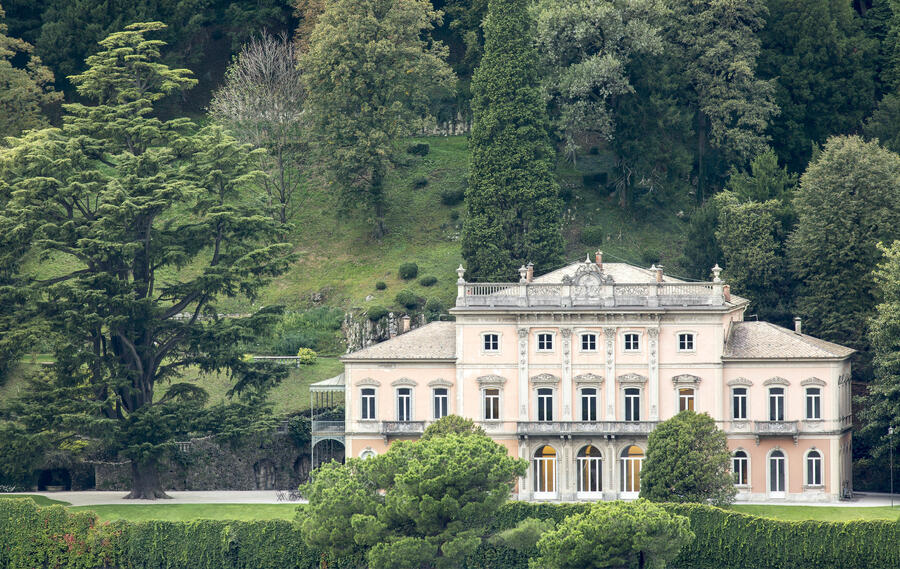
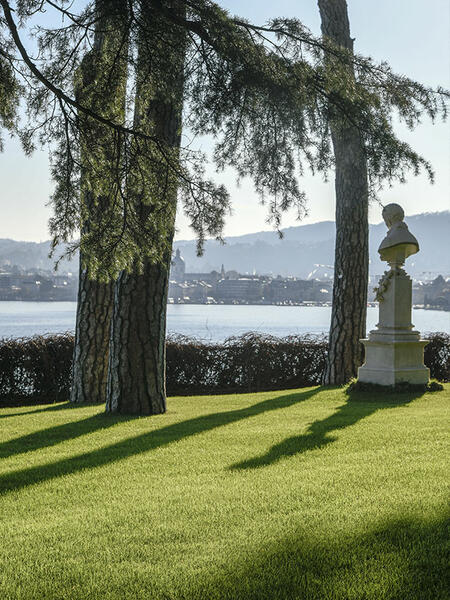
Lake Como Design Festival once again opens Villa del Grumello and its historic park to the public as the setting for a new exhibition itinerary. Future in the Past explores the relationship between memory and design, bringing together archives, manufacturing knowledge, and contemporary design practices. Far from presenting the archive as a mere repository of the past, the exhibition reimagines it as a living space capable of generating new possibilities. Future in the Past invites visitors to see the past not as something to be preserved unchanged, but as a body of knowledge to be reinterpreted through design. It is in the dialogue between heritage and innovation that design finds its capacity to imagine the future, transforming memory into a creative practice and the archive into a laboratory of possibilities.
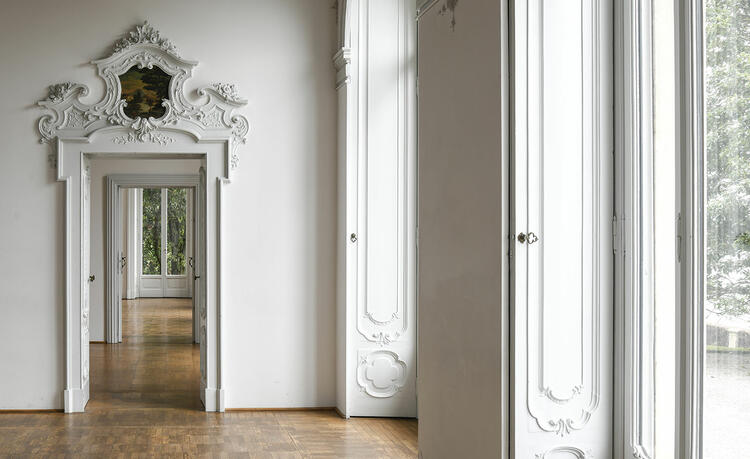
Villa del Grumello, Como
Among this year's projects is Disegno Nomade by artist Lupo Borgonovo, in collaboration with Lithos Edizioni and Jaipur Rugs, whose large-scale drawings are based on buckles once belonging to the nomadic peoples of Eurasia. These contemplative images reveal traces of ancient ruined cities, zoomorphic forms, and barely recognisable faces. Alongside the drawings, five etchings retrace the outlines of the same buckles, exploring the memory embedded in metal. AG Fronzoni’s archival work enters into dialogue with his Collezione 64, published by Cappellini, where the boundary does not take on a decorative value, but a structural one. It becomes a space of tension and relationship: an element that defines, connects, and opens up new possibilities of interpretation between form, function, and design thinking.
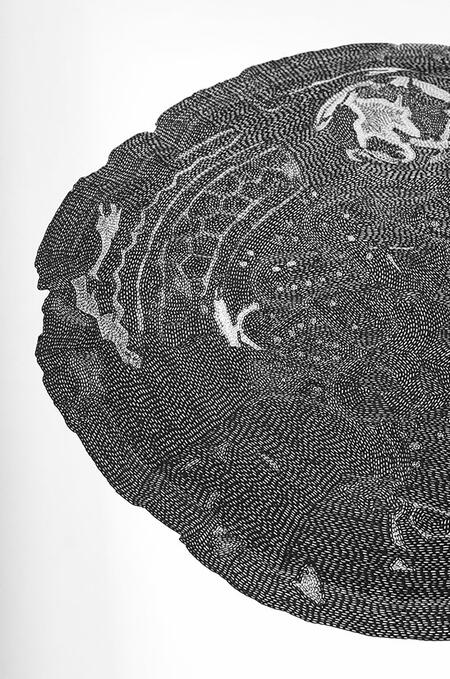
Disegno Nomade, Lupo Borgonovo, 2025
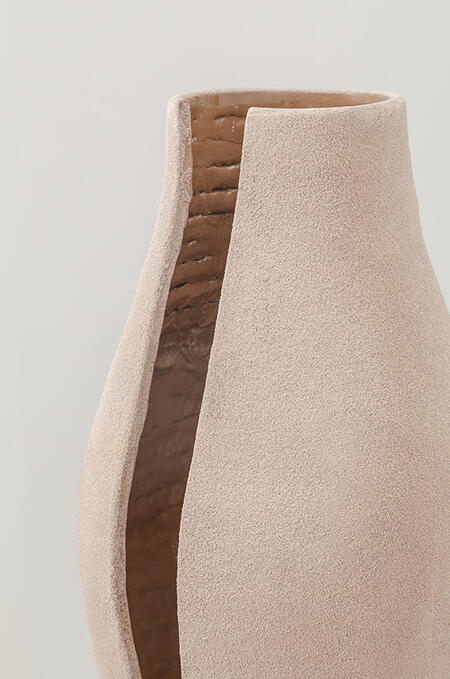
Proporzione Mediterranea, Architetti Artigiani Anonimi, 2022
For designer Nicolò Spinelli and Simonetto, the historic woodworking atelier from Meda, the border is not a limit but a threshold to be crossed. Their architectural intervention, designed by Elisa Ossino, takes the form of a gradient eucalyptus wood panelling that embraces the historic interiors while preserving their identity. Etel returns to the festival with a vertical exhibition dedicated to Lina Bo Bardi and her work as a furniture designer in Brazil. On display are some of her most iconic pieces, including the Carrinho de Chá and the Cadeira de Balanço. Proporzione Mediterranea invites visitors to rediscover the most fundamental idea of architecture: a space shaped in harmony with its landscape, climate, and the needs of those who inhabit it. Conceived by Annarita Aversa of Architetti Artigiani Anonimi and curated by Giustini Stagetti Gallery in 2022, the project stems from the designer's research into the vernacular architecture of the Mediterranean, particularly the vaulted houses of the Amalfi Coast.
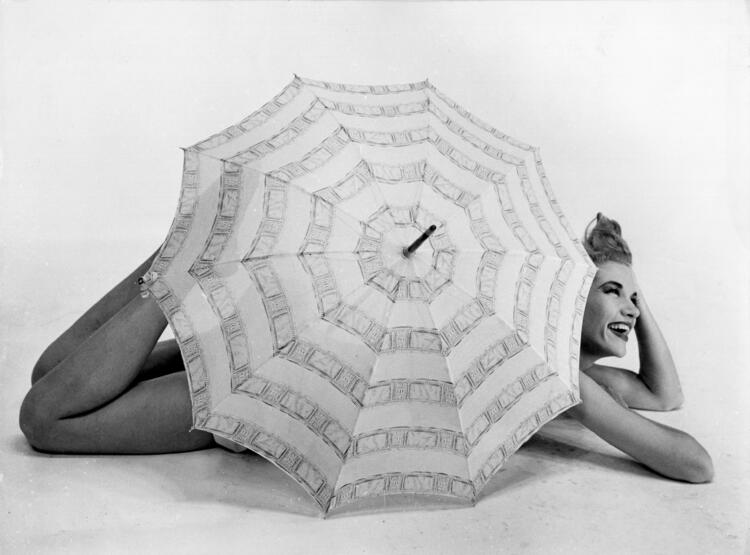
Umbrella made with printgivenchy, Sabrina collection. Photo by Elsa Haertter, 1955. Family Legler Archive, Ponte San Pietro.
The notion of the border as a site of creative exchange is explored by the Carla Badiali Archive, presenting a selection of drawings primarily derived from Carla Badiali's collaborations with Hubert de Givenchy and Pierre Balmain. The works reveal key aspects of her artistic research, including creative processes, the constraints of textile printing, and the influence of Eastern visual traditions. Eredi Marelli returns, entrusting the theme of "the boundary" to an extraordinary bar cabinet designed by Paolo Buffa in 1948. The piece is enriched with engravings based on Andrea Appiani's drawings for The Deeds of Napoleon, the decorative cycle that once adorned the Hall of the Caryatids at Milan's Royal Palace. Although the original decoration was destroyed during the bombings of the Second World War, it survives through these engravings.

1in16 – A Border Divided, a Story Shared, a project curated by Francesca Brambilla and conceived by Paolo Vallara, is grounded in the relationship between integrity and separation: a condition in which unity, through division, does not dissolve but unfolds into a plurality of forms. The artists Alessandro Busci, Giovanni Frangi, Jonathan Guaitamacchi, Andrea Mariconti, Maddalena Parise, Leo Ragno, Alessandro Verdi and Jonathan Wajskol were each entrusted with a whole sheet—a continuous surface of AnimaGrigia®, conceived as an original, unified, compact and undivided field. It is upon this totality that each artwork is created, reaching its full completion precisely when it undergoes a process of decomposition. Each module has become the cover of a notebook: autonomous yet deeply interconnected. The notebooks will be sold as unique pieces during the festival days, with the proceeds contributing to the funding of the 2026–2027 Educational Programme, aimed at primary and secondary school students in the provinces of Como and Lecco and promoted by Wonderlake Como ETS.
FUTURE IN THE PAST
Villa del Grumello
Como, via per Cernobbio 11
13-20 September 2026
10 AM - 7 PM
entrance with ticket