
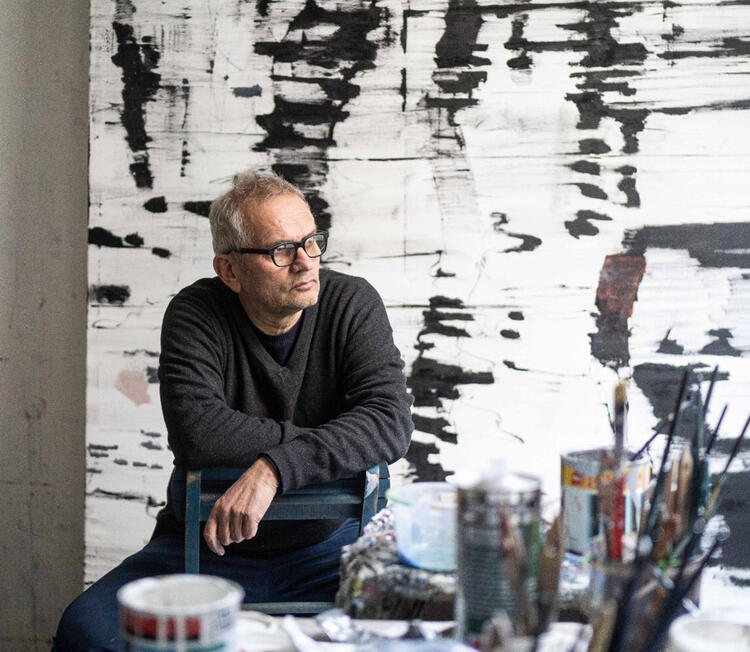
Giovanni Frangi was born in Milan in 1959. He studied at the Brera Academy of Fine Arts and made his debut in 1983 at Galleria La Bussola in Turin. In 1986, he exhibited at Galleria Bergamini in Milan; the exhibition catalogue featured a text by Achille Bonito Oliva. This was followed by numerous solo exhibitions, including La fuga di Renzo at the Sala del Cenacolo in Montecitorio, Rome (1998), where he began his collaboration with Giovanni Agosti; Il richiamo della foresta at Palazzo delle Stelline, Milan (1999); Nobu at Elba at Villa Panza, Varese (2004); Pasadena at the Galleria d’Arte Moderna in Udine (2008); MT2425 at the Oratorio di San Lupo, Bergamo (2008); La règle du jeu at Teatro India, Rome (2010); and Giardini pubblici at MART, Rovereto (2010).
In 2011, he presented Straziante, meravigliosa bellezza del creato at Villa Manin in Passariano di Codroipo, followed in 2013 by Sheherazade at the Museo Nazionale di San Matteo in Pisa. In 2014, he created a banner for MAXXI in Rome, Mollate le vele, followed by Alles ist Blatt at the Botanical Garden of the University of Padua and Lotteria Farnese in the Sala della Meridiana of the Museo Archeologico Nazionale di Napoli. In 2015, he exhibited Settembre at Palazzo Poli in Rome and Usodimare at CAMeC in La Spezia. In 2017, Prét à pôrter was presented at Palazzo Fabroni in Pistoia, as part of the inauguration of the city’s year as Italian Capital of Culture. In 2019, he presented Urpflanze at Villa Carlotta in Tremezzo. In 2020, he exhibited at Palazzo delle Paure in Lecco, in dialogue with a work by Lorenzo Lotto. In 2021, Vocali, inspired by the poetry of Rimbaud, was presented at Stamperia Albicocco in Udine. In 2022, he exhibited Vitaliana at Palazzo Parasi in Cannobio. In 2023, he presented Showboat. Andata e ritorno at the Castello Sforzesco in Milan, in the Gabinetto della Grafica and the Sala del Tesoro. In 2024, Le mille vite di Showboat was presented at the Galleria d’Arte Moderna in Arezzo. In 2025, Nobu at Elba. Redux opened in Milan at the Sala Stirling of Palazzo Citterio, part of the Grande Brera. In 2026, he presents Vera da pozzo at the Museo San Domenico in Imola.
His works are held in public collections, including the Gabinetto dei Disegni of the Uffizi Galleries, Florence; the Chamber of Deputies, Rome; MART, Rovereto; Castello Sforzesco, Milan; the Istituto Centrale per la Grafica at Palazzo Poli, Rome; CAMeC, La Spezia; the Galleria d’Arte Moderna, Udine; Palazzo Forti, Verona; Palazzo Fabroni, Pistoia; the Museo Diocesano, Milan; the Pinacoteca di Brera, Milan; the Quirinal Palace, Rome; and Villa Reale, Monza.