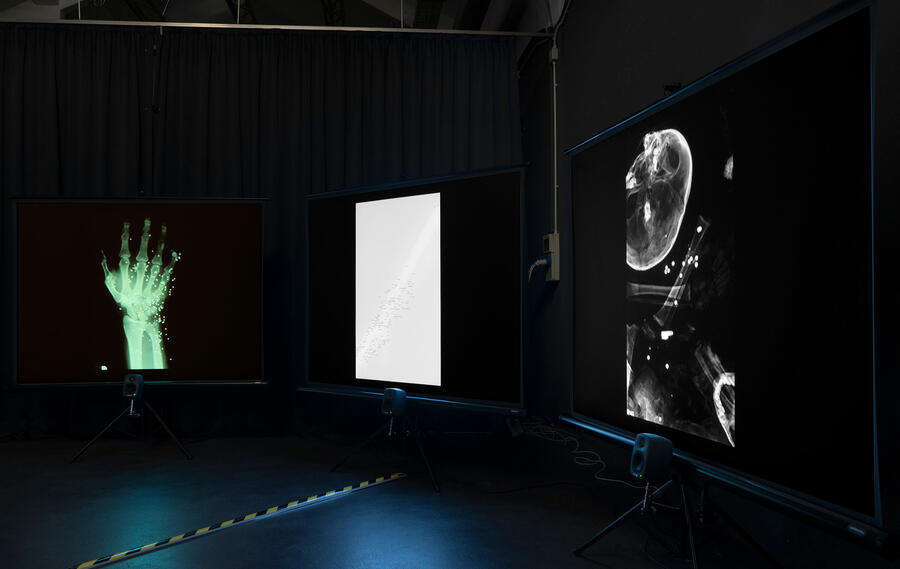
What is the border between past, present, and future? It is not merely a matter of distinguishing where one ends and another begins, but of recognizing the space where these times meet, overlap, and transform. It is a diffuse border that connects rather than divides, where temporalities coexist and take shape through their intertwining. It is at this very point that future memories are built.
This reflection is developed within the program of the eighth edition of the Lake Como Design Festival, featured in the third issue of Notes on Plural Intelligences, the editorial project by IED Istituto Europeo di Design created on the occasion of the school's 60th anniversary.
These themes find expression in the exhibition project After Evidence: from forensic purpose to public resonance, the outcome of a research path on archives developed within the research project Sounding Images, Screening Sounds (SISS). This project focuses on the relationship between music and image and was granted European Union - NextGenerationEU funding through the PNRR by the Ministry of University and Research. The exhibition will be presented within the spaces of the Accademia di Como Aldo Galli.
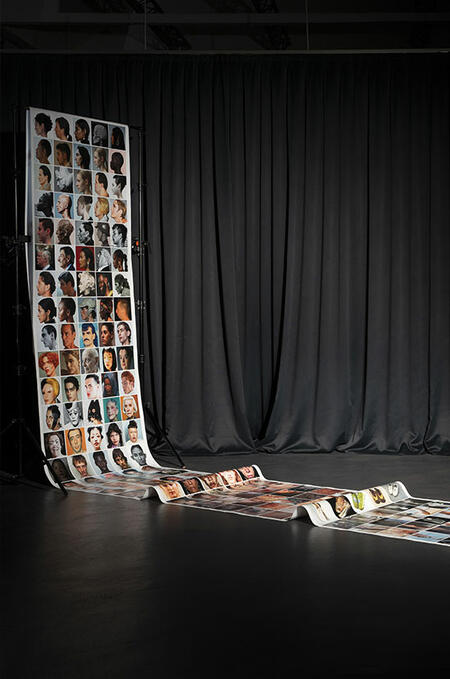
EVIDENCE OF BEAUTY, by Defne Akin - Berk Özmutaf. Installation view by Giulia Pirri.
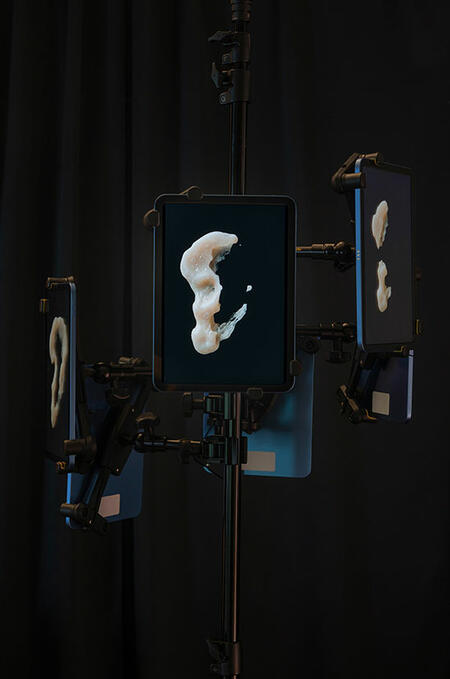
DISSOLVING TOUCH, by Jacinta Bosch. Installation view by Giulia Pirri.
After Evidence is born from an engagement with an archive of forensic images, aiming to restore a new public presence to these materials. The works engage with visual and sound fragments, details, voices, and barely perceptible traces. Instead of translating forensic material into a linear narrative, they build a slow proximity, where looking and listening become ways to linger alongside what remains partial, fragile, and not immediately deducible.
The project grows out of the dialogue between IED and LABANOF–MUSA. LABANOF, the Laboratory of Forensic Anthropology and Odontology at the University of Milan, works on the body and human remains to contribute to identity reconstruction, the understanding of life and death circumstances, and the protection of human rights. This experience gave rise to MUSA, which opens to the public a research space where science, medicine, archaeology, anthropology, and civil responsibility meet. Inside is the CAL, the Labanof Anthropological Collection, a collection of about 20,000 skeletons spanning a period of nearly 2,000 years. It is not only one of the largest skeletal collections in Europe, but a heritage of traces through which the history of our society can be read through signs of violence, migration, health, disease, and inequalities.
The forensic images here are not evidence to be exhibited, but materials defined by a function and by the responsibility to observe, document, verify, and recognize. After Evidence accompanies them beyond that initial purpose, asking how something born to establish a truth can transform into a space of listening, attention, perception, and memory. It opens a dialogue with the border understood as a condition of relationship: between art and science, authorial gesture and forensic observation, past and present. The works neither offer answers nor transform science into a metaphor, but inhabit a threshold of perceptible presence that concerns everyone.
AFTER EVIDENCE
Accademia di Como Aldo Galli
Como, Via Francesco Petrarca 9
12-20 September 2026
10 AM–7 PM
free entrance