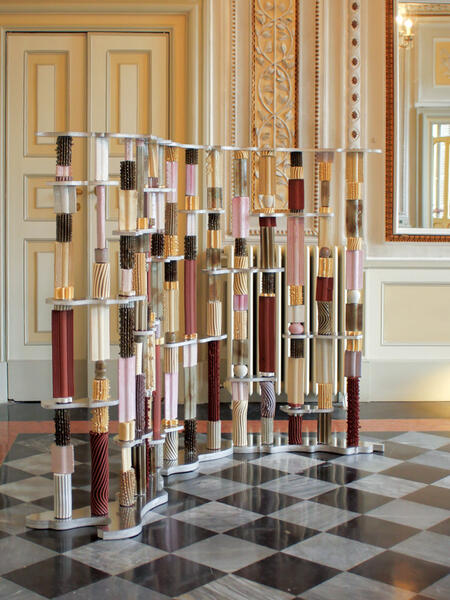
Room divider in ceramic and aluminium
Claustra
2026
Our Claustra defines space without enclosing it. Grounded in clay and shaped into organic, almost vegetal forms, this room divider establishes a boundary that feels instinctive rather than imposed.
It does not interrupt movement, instead it guides it, much like a tree, a current, or a shifting landscape. The body responds intuitively, adapting rather than resisting.
In this sense, the project rethinks the idea of borders, not as rigid separations, but as permeable thresholds. The divider holds a presence while remaining visually open, allowing a continuous dialogue between spaces.
It softens transitions, maintaining connection while introducing a sense of distance that is calm, balanced, and respectful. Transparency becomes an active condition, one that both separates and invites, without evoking tension or unease.
Material and process reinforce this duality. The divider is composed of extruded stoneware elements, each varying in shape and surface. Extrusion itself is an act of constraint, clay is compressed, forced through a fixed geometry, and then released.
This moment of tension, between control and release, remains inscribed in each piece, visible in its subtle irregularities and dynamic forms. The project embodies a paradox central to the theme, boundaries that do not confine, structures that hold space while allowing freedom.
It proposes a softer architecture of limits, one that is negotiated through perception, movement, and material memory rather than imposed through solid division.
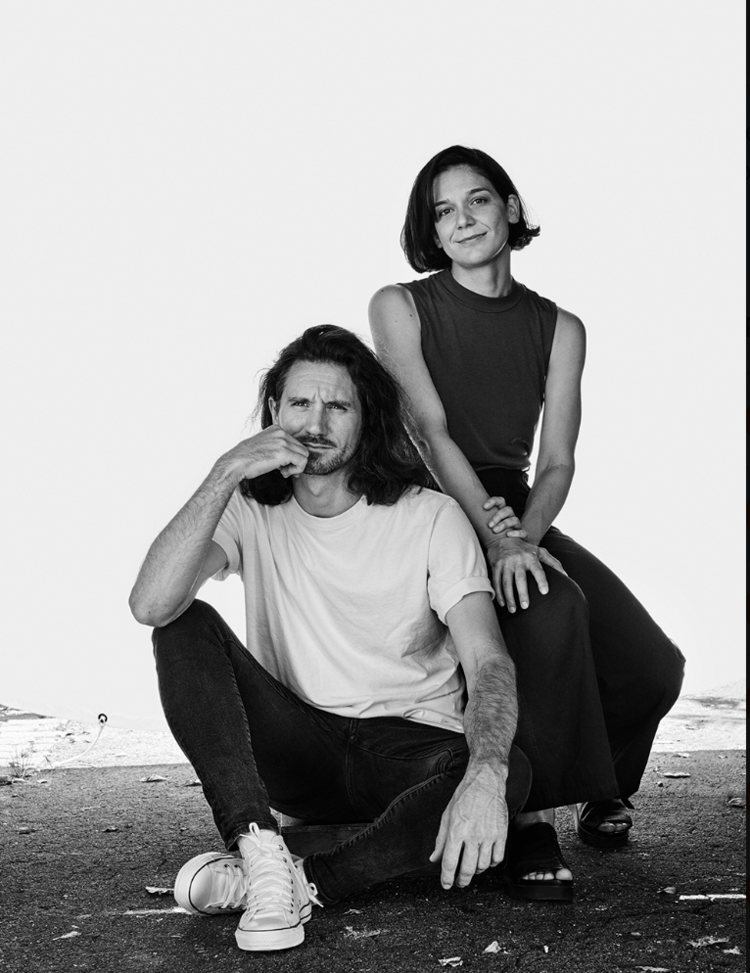
What’s Wrong Duo is a design studio based between Zurich and Bucharest, founded in 2024 by Sandra Berghianu and Julien Hauchecorne.
Coming from different backgrounds but united by a shared interest in ceramics, the duo brings together complementary skills and perspectives, shaping a hybrid practice that merges techniques across collectible design installations and sculptural objects. Their work explores material behaviour, process, and form through a continuous dialogue between control and spontaneity.
Driven by research, experimentation, and discovery, they embrace failure as an essential condition of their process—an active tool rather than a limitation. Rooted in manual work, their pieces remain honest to their making, revealing rather than concealing the traces of production. Working as a duo inherently introduces tension, contrast, and negotiation —qualities embedded in both their methodology and the forms they produce.