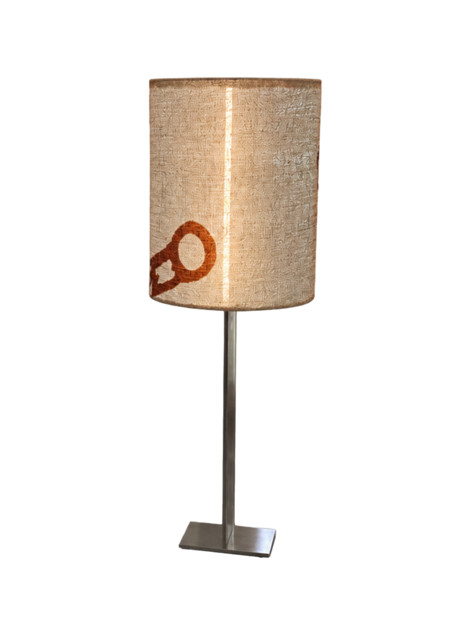
Stainless steel, Amazigh wool textile (c. 1880), LED lighting.
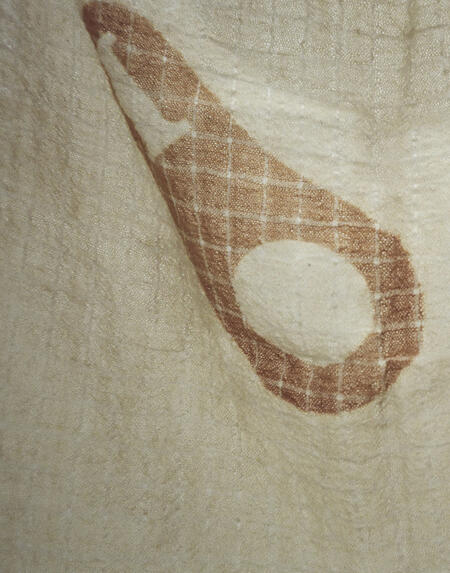
Threads of Origin
2026
Border in Threads of Origin can be understood in several ways. First, it refers to the cultural boundary between contemporary Western design and ancestral Moroccan craft traditions. The textile at the core of the project is rooted in Berber culture and shaped by centuries of Amazigh, Arab, and Jewish influences, reflecting a rich and layered cultural heritage. The project seeks to bridge these worlds, making local knowledge and material practices accessible to a broader audience while preserving their cultural significance.
The border also exists in contrasting approaches to production and sustainability. Rather than following the logic of fast manufacturing, the project embraces a slower and more intentional design process rooted in ritual, craftsmanship, and the value of the object being created. In this context, a pre-industrial weaving technique is paired with contemporary stainless-steel structures, creating a dialogue between inherited knowledge and industrial production.
Finally, the project explores the border between different design perspectives. It represents a collaboration between designers from distinct cultural backgrounds, merging Italian heritage with Polish craft sensibilities. Through this exchange, the work becomes a space where diverse traditions, perspectives, and forms of knowledge meet, challenge one another, and evolve together.

Xenia Kwiatkowska and Vittorio Di Girolamo are designers based in New York whose collaborative practice explores how objects carry cultural and social memory. Working between industrial design, anthropology, and craft, they investigate the relationship between material, ritual, and belonging through site-specific research and collaboration with artisan communities. Kwiatkowska’s work focuses on the tension between handmade traditions and contemporary production, while Di Girolamo approaches design through ethnographic fieldwork and material culture.