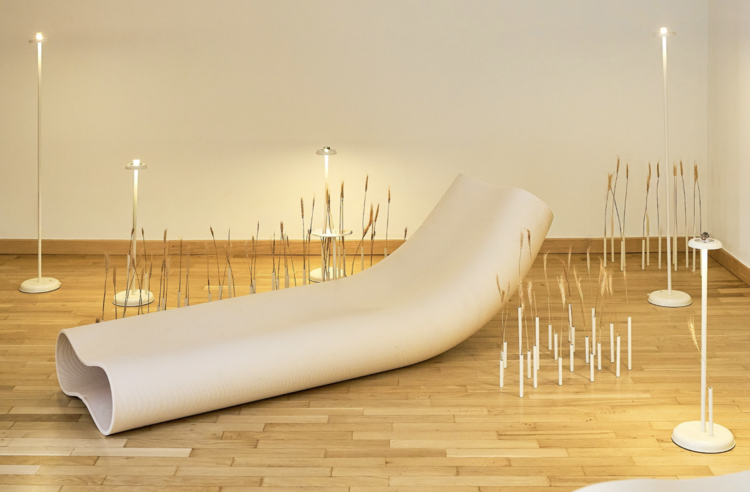
Chaise longue in cellulose, wood-filled PLA composite
Tattile – Daybed Lounge
2026
A border begins as a line. Drawn to separate, contain, or define, it marks the edge between one thing and another. Yet a line can also wander. It can loosen into a sketch, drift into a thought, or unfold into a daydream. In Tattile, Studio Yellowdot reimagines the border not as division, but as possibility: a continuous gesture that softens distinctions between body and object, food and furniture, technology and touch. What once defined the border becomes an invitation to recline, gather, and imagine otherwise.
The project transforms an imagined line into a sculptural daybed for rest and contemplation. Like a strand of pasta suspended in motion, the form loops fluidly through space, dissolving into a continuous surface that cradles the body. The work proposes that borders are never fixed; they bend, blur, and reconnect through human interaction, sensory experience, and acts of play.
Balancing softness and structure, instinct and technology, the work exists between categories: food and furniture, object and experience, digital production and human intimacy. More than furniture, Tattile functions as a design artefact and multisensory ritual. Through rhythm, touch, and temporary moments of gathering, the project explores how borders between disciplines, behaviours, and sensory experiences can soften, dissolve, and reconnect through design.
Conceived for Barilla’s 3D-printed pasta brand Artisia, Tattile is a bespoke sculptural daybed designed for lightness, relaxation, and the pleasure of the moment. Inspired by the hollow geometry of pasta forms, the furniture appears as though a single strand of spaghetti has been enlarged and gently rolled into space—forming a continuous surface that invites the body to slow down, contemplate, and daydream. Familiar yet surreal, the form occupies an ambiguous territory between edible object and inhabitable sculpture.
Tattile—Italian for “tactile”—takes its name from the corresponding 3D-printed pasta shape designed by Studio Yellowdot. The pasta form itself is inspired by the pinch of the fingers: the small, instinctive gesture of lifting something delicate. These subtle indentations become the defining language of both food and furniture. Across the daybed, curves softly recede where the legs, back, and body meet the surface, allowing the solid form to cradle and embrace the body with surprising comfort. The object responds to the body almost intuitively, embedding traces of touch into a digitally produced form.
The hollow structure features an infinity-like curvature, where the legs, seat, and backrest merge into a single, continuous movement. Integrated side plates create moments for resting and sharing Artisia’s pasta as finger food, encouraging interaction beyond the conventions of the dining table. Visitors are invited not only to sit or recline, but also to engage socially and sensorially through eating, touching, and gathering. Each contour follows touch, inviting the hand to rest, lift, and engage—translating intimate bodily gestures into architectural scale.
Created from Cellulose—a wood-filled PLA composite containing sawdust—the material carries a warm natural-beige tone and matte texture reminiscent of dried semolina pasta. The finish softens the precision of digital fabrication into something familiar, warm, and approachable. Printed in a single continuous movement by a 6-axis robotic arm over more than twelve hours as one seamless piece by LAMÁQUINA in Barcelona, Tattile transforms additive manufacturing into a choreographed spatial performance. The robotic nozzle moves fluidly around the curvature as though sketching in mid-air, tracing a line that gradually becomes structure, surface, and space.
Rather than presenting technology as cold or distant, Tattile seeks intimacy within precision. The project explores how digital fabrication can preserve softness, humour, tactility, and emotional resonance. By merging the language of pasta-making with robotic production, the work dissolves borders between craft and industry, nourishment and leisure, the domestic and the speculative. In doing so, Tattile proposes an alternative vision of future living—one where objects encourage slowness, curiosity, and shared sensory experience.

Yellowdot is a design studio and creative consultancy founded by and Bodin Hon and Dilara Kan Hon, working across collectible and industrial design, lighting, furniture, and spatial projects.
Based between Istanbul and Hong Kong, the studio merges technology, craft, and sustainability
through a bold, playful visual language. Drawing on Dilara’s background in fine arts and interiors and Bodin’s in bioengineering and industrial design, Yellowdot celebrates the meeting of opposites — logic and emotion, art and science, East and West — to imagine new possibilities for design. The studio embraces cross-cultural and interdisciplinary thinking, engaging in projects that span product and spatial design, consultancy, and independent experiments, transferring knowledge between fields and redefining categories through design.
Their work has been exhibited internationally, including at Triennale di Milano and Odunpazarı Modern Museum (OMM), and presented at Milan Design Week, where they returned in 2026 with a multi-sensorial installation in collaboration with 3D-printed pasta brand Artisia by Bariila.
Their work has earned international recognition — including the Int’l Compasso d’Oro, Red Dot Design Award, and ELLE Decoration International Design Award — affirming Yellowdot’s role as a studio that bridges imagination and industry to shape the future of design.