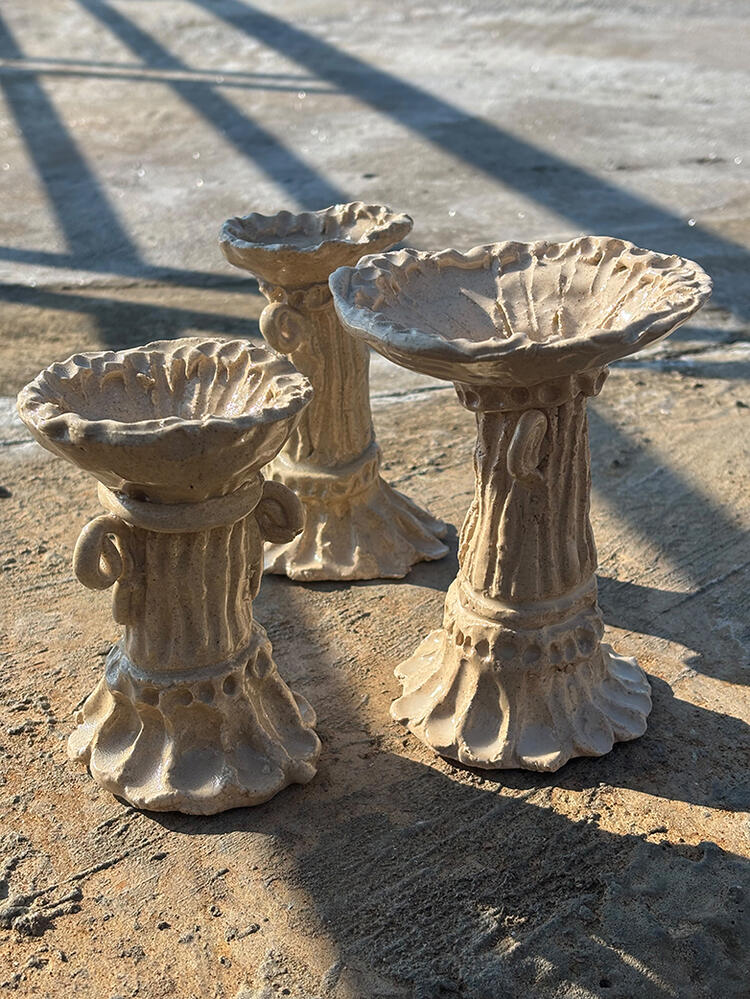
Vases in ceramic
Whispers
2026
Sibylle Tamer’s work explores the idea of borders between past and present, architecture and poetics of illusion.
Ancient forms shift into new meanings, crossing boundaries between memory and phantasmatic reimagination.
At the heart of Sibylle Tamer’s work lies a fascination with the Greek column — an architectural form that has travelled through centuries, carrying with it ideas of beauty, balance, strength and memory. Through Atelier SZ, Sibylle approaches it by her hand that reimagines the erotic of the Doric virility and suggests a welcoming to her female sensibility, transforming fragments of classical architecture into objects made to be seen, touched and lived with.
Her creations are not reproductions of ancient forms. They are interpretations. Columns are reshaped, proportions shift, surfaces become irregular, and architectural details take on new functions. A capital can become a vessel; a fragment of a column can become a sculptural object. What once belonged to monumental architecture is brought down to a human scale.
There is something deliberately imperfect about these pieces. Their lines are not rigid or perfectly symmetrical. Their surfaces reveal traces of the hand, giving each object its own presence and personality. This irregularity creates a dialogue between the permanence we associate with classical architecture and the spontaneity of contemporary craftsmanship.
For Sibylle, the connection to Greece is also personal. Even her name carries an echo of the ancient world: The Sibyls were prophetic female figures of antiquity, associated with intuition, mystery and the ability to see beyond the present. This connection is not treated literally in her work, but it adds another layer to her relationship with Greek history and its visual language.
Rather than looking at antiquity with nostalgia, Sibylle approaches it beyond domination.
Through Atelier SZ, she asks what happens when an ancient form is removed from its traditional context. Can a monumental column be taken over after a restful domination and pour over an intimate dimension?
The new collection explores precisely this transformation.
Replacing rigidity by rhythms and ornamental antithetical details, the pieces retain traces of their architectural origins while developing a language of their own. Some are elongated and almost architectural; others are smaller, softer and more organic. Openings at the top transform the column-like structures into vessels, while sculpted bases and capitals become expressive elements rather than purely architectural ones.
The result sits somewhere between sculpture, design and functional object.
This ambiguity is essential to the work. Sibylle is interested in objects that do not need to belong entirely to one category. A piece may hold something, but it can also exist simply for its form. It may evoke an archaeological fragment while clearly evoking contemporary stakes. It can feel familiar and strange at the same time.
Material plays an important role in creating this tension. The tactile surfaces and visible imperfections contrast with the idealized perfection traditionally associated with classical architecture. Instead of polished marble and monumental scale, these objects reveal texture, movement and traces of making.
They feel almost as though they have been discovered rather than manufactured.
Time is therefore present throughout the collection, but not in a linear way. Ancient references coexist with independent gestures. Forms that seem archaeological are newly imagined. The past is not reconstructed; it is transformed.
This relationship between memory and imagination is central to Sibylle’s practice.
The Greek column is one of the most recognizable forms in Western architectural history, yet here it becomes something more personal and playful. Freed from the responsibility of supporting a building, the column can change character. It can become delicate, exaggerated, imperfect or unexpected. Rather than standing alone, it suggests an unexpected partnership of opposites.
By changing its scale and purpose, Sibylle invites us to look again at a form we think we already know.
These objects can live beside us. They can sit on a table, hold flowers or simply occupy a space as sculptural presences. The distance between museum and home, monument and object, antiquity and the present, begins to disappear.
This is perhaps where Atelier SZ finds its distinctive language: in the meeting of seemingly opposite worlds.
Ancient and contemporary.
Monumental and intimate.
Architectural and handmade.
Memory and imagination.
Rather than choosing between them, Sibylle allows these ideas to coexist.
The familiar vocabulary of Greek antiquity is taken apart and assembled again with a different sensitivity, creating objects that carry history without being defined by it.
The work is ultimately less about recreating Greece than about exploring what remains of a form after centuries of lasting classicism. The column becomes a starting point, a structure from which new possibilities can emerge.
Through Atelier SZ, Sibylle Tamer gives these ancient forms another chance to expand in the world.

Sibylle Tamer is a Lebanese designer whose work is shaped by emotion and personal experience, reinterpreting traditional craftsmanship through a contemporary lens. Raised between Lebanon and Paris, she studied Fine Arts at ALBA before continuing at Parsons School of Design in New York. Her work has been exhibited internationally across Europe and the Middle East, with recent appearances at Salone del Mobile and We Design Beirut Open Studio 2025.