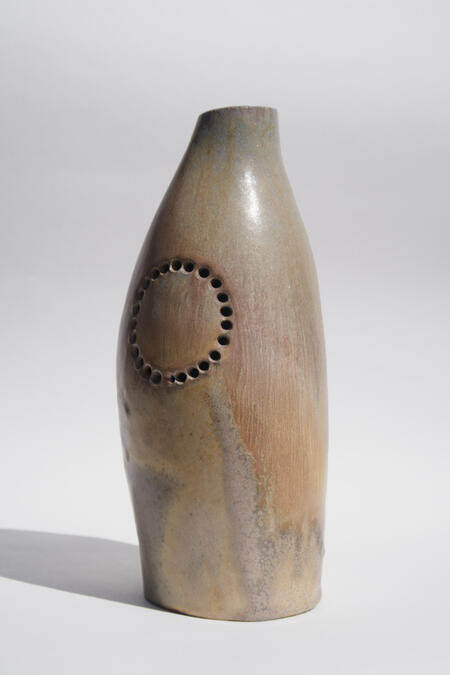
Vases in stoneware and glazes
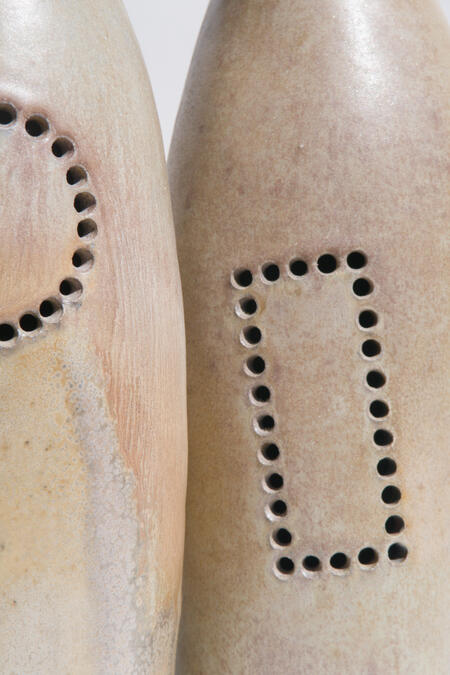
(in)continent
2024
This work is composed of two wood-fired ceramic bottles.
Ceramics have historically been defined through the logic of the vessel a constructed solid boundary that separates interior from exterior, containment from exposure.
In this work, each bottle is punctured by a series of small perforations carved into the clay wall. These are intentionally added to destabilize their conventional role as a protective container and opening it to a more conceptual and poetic interpretation.
By perforating the clay, the vessel's boundary shifts from a rigid barrier into a "porous skin". The solid wall becomes a site of transition.
Although the objects retain the recognizable form of a bottle, their capacity to contain is compromised.
The vessel emerges as a negotiation of limits - defined at the precise point where the boundary that is supposed to ensure enclosure gives way to passage. Inside and outside begin to dissolve.
This threshold produces a tension between retention and release, between function and failure.
These works emphasize that boundaries - whether physical or conceptual are never truly static, they are thresholds waiting for the moment of liberation.
The perforations are inspired by the logic of perforated paper or postage stamps systems designed to anticipate separation. Just as a stamp is designed to be detached from a larger sheet, these bottles suggest the possibility of removal and transformation. By detaching or "highlighting" these sections, the user can actively alter the form and function of the bottle. In this sense, the boundary is neither stable nor absolute, but contingent and performative subject to transformation through gesture, use, or time. What appears as a coherent whole already contains the conditions of its fragmentation. Echoing the language of cartography, the circular and rectangular perforations inscribe a boundary within a boundary, suggesting a second layer of sovereignty embedded within the object itself.
The choice of geometry introduces a symbolic dimension: The circle evokes the organic, the continuous, the infinite. The rectangle signals the rational, the constructed, the human-made.
In conclusion, this work reflects on the nature of limits. By transforming the traditional vessel into an exercise in porosity, these pieces demonstrate that a boundary is not just a point of closure, but a site for potential transition.
Even the most solid vessels can become open territories, proving that the concepts we believed to be absolute can be challenged and redefined. They remind us that it is often at the point of failure the leak, the tear, the rupture that true liberation is found.
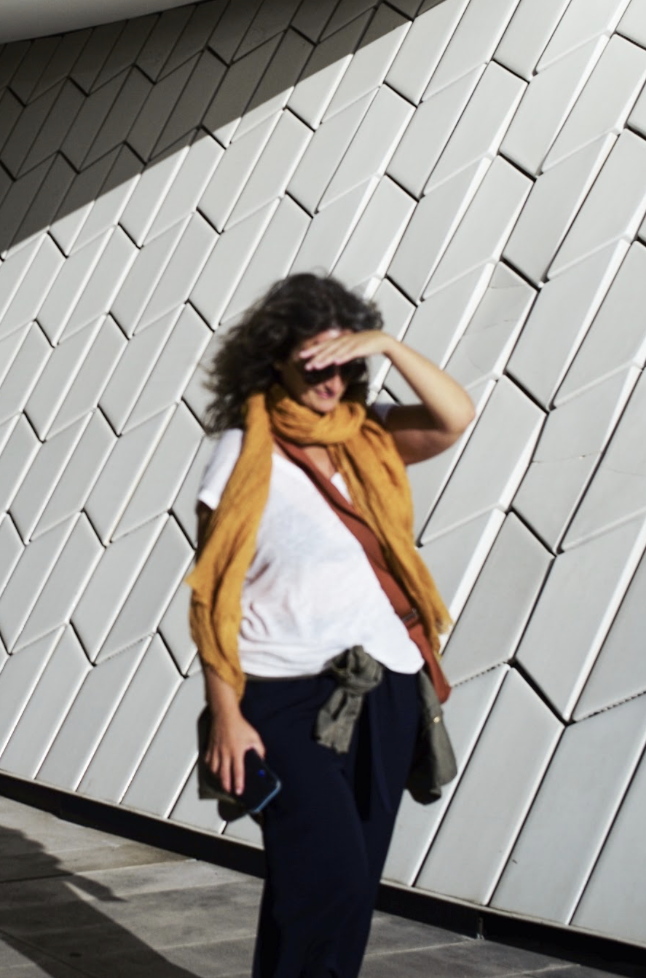
After a decade working as an architect, I sought a more intuitive and tactile form of expression.
Ceramics became my way to reconnect with gesture and materiality.
I first worked with porcelain - delicate, temperamental and demanding - using coil building and intentionally exposing the joins to create textures that shift with light and shadow.
Wood firing and stoneware recently transformed my practice, allowing me to explore the material's earthiness and the surfaces shaped by flame and ash, embracing unpredictability.
I am interested in challenging the classical idea of ceramics as vessels, pushing forms towards sculpture and exploring the tension between function and non-function.