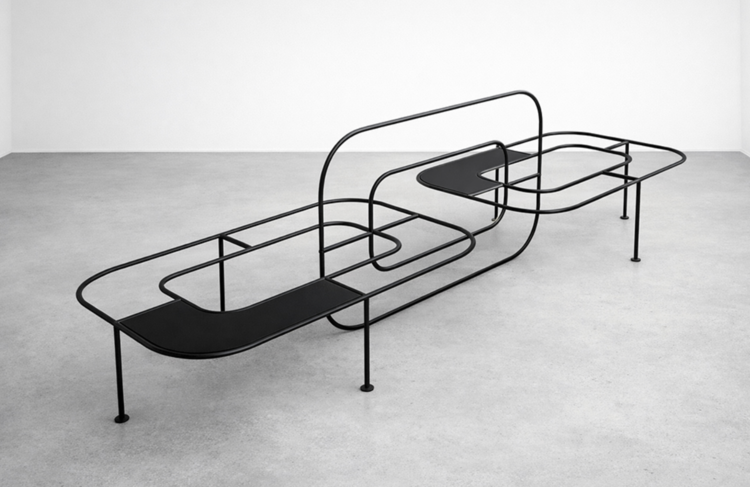
Bench in steel
Chain
2026
A chain is a clear and recognizable symbol of a boundary. In public space, it often marks territory, blocks access, or separates one area from another. It can represent control, restriction, or distance. In this sense, it is a physical sign of division.
However, a chain also has another meaning – it is made of connected links. Each link is separate, but only together do they create a whole. It is therefore also a symbol of connection and interdependence.
In this project, this double meaning is reinterpreted. Instead of separating, the chain begins to connect. The installation does not close the space; it invites people to stop. It can function as a bench, a place to rest, or a meeting point. A former symbol of limitation becomes a shared element – something that supports presence and conversation. In this way, the project reflects the idea of the boundary as a space of contact and exchange.
The form of the installation is visually open and light. The structure, made of welded steel tubes, creates a spatial drawing – a black outline in space. It is not a solid wall, but an open framework. Because of this, the boundary is not hard or impenetrable. It becomes a frame that defines a place without blocking it.
Modularity is also important. Three connected elements create a repeatable structure that can be expanded or adapted to different contexts. The installation can function both indoors and outdoors – in a garden, courtyard, or urban space.
Each time, it acts as a point of transition between different conditions: between architecture and landscape, movement and rest.
Chain suggests that a boundary does not have to be only about division. It can also
be a shared space – a place where people and meanings meet. The project does not deny the existence of borders, but proposes to see them differently: as something that can connect instead of separate. In this way, the installation becomes a clear and simple response to the theme of Border – the boundary as a place where one space ends and a relationship begins.
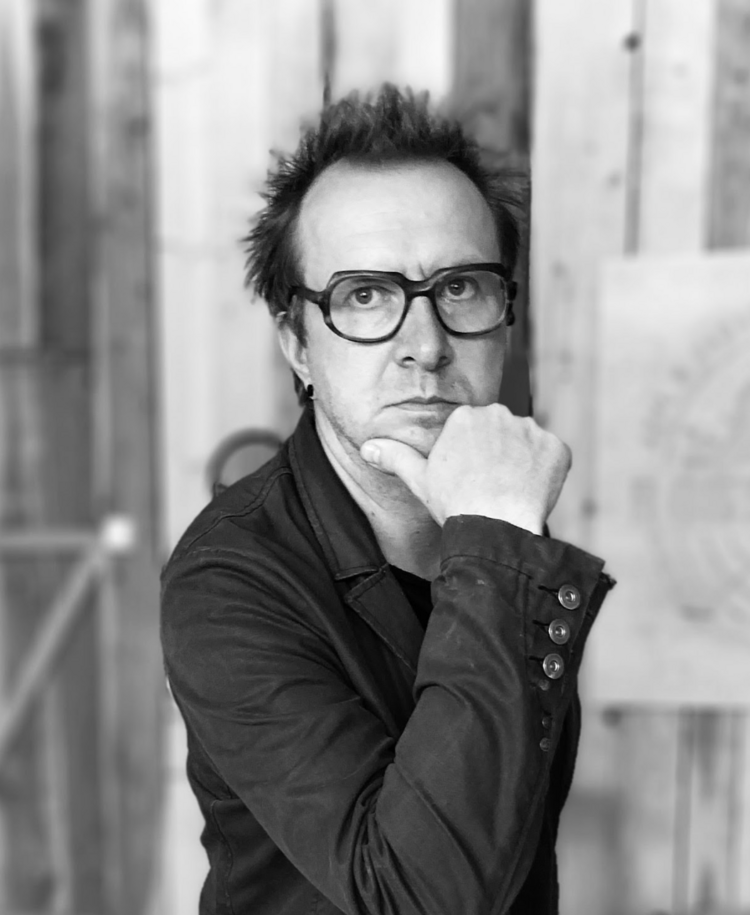
Bartosz Mucha is a 2D and 3D designer and a graduate of the Academy of Fine Artsin Kraków (MA diploma, 2004). During his studies he completed a semester at the
École Supérieure d’Arts Graphiques in Paris, expanding his practice within an
international design context. His work operates at the intersection of design, art,
and para-architecture.
Between 2004 and 2011 he was the vocalist and lyricist of the math rock band Maria Celeste, an experience that shaped his sensitivity to rhythm, structure, and narrative—qualities that continue to inform his design approach.
He is the founder of Poorex, a one-person design and artistic studio functioning primarily within the gallery circuit and in collaboration with cultural institutions. The studio focuses on unique objects and short series, positioned between experimental design and art. Poorex is grounded in three key principles: experiment, object, and para-architecture.
His projects are often accompanied by short video pieces that extend their narrative context, while book publications serve as an important culmination of selected object series. Alongside his studio practice, Mucha is engaged in teaching, encouraging students to develop conceptual and experimental approaches to design. He is currently affiliated with the Faculty of Design at SWPS University.