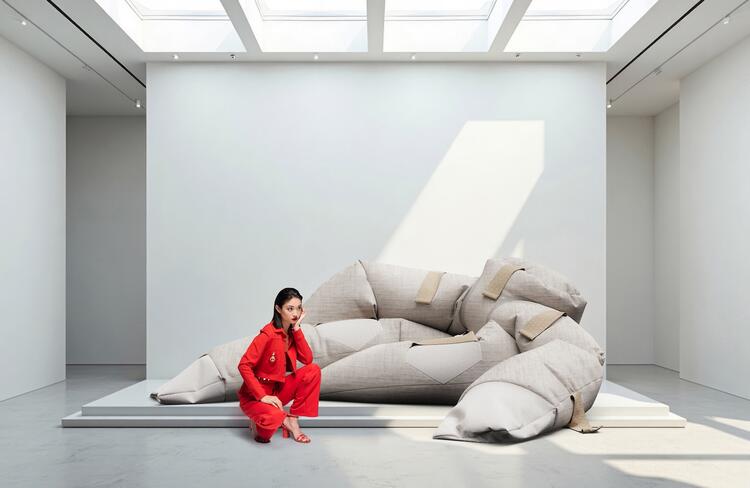
Upholstery in Groma, 3D knitted textile designed by Pastina for ByBorre, PU foam padding and leather details.
Soft Monuments
2026
A single body, devoid of gesture, yet capable of immediately altering the perception of a place. Its presence is dense, introducing a silent gravity: a new order, an equilibrium that is not grasped solely by sight but felt in depth, like an atmospheric shift.
It is stone, and yet it radiates charisma.
In Rome, one only needs to turn a corner to encounter a presence that has remained there for centuries.
The encounter is destabilizing: that silent figure redraws the space and, for an instant, unsettles the balance of the observer. In that encounter, a boundary reveals itself, not a line of separation, but a threshold: the point at which a trajectory is interrupted and takes on a different measure. The ancient monument does not exclude, it redefines. It is a soft boundary, one that does not divide but brings into relation.
From this experience arises the intention to design a presence capable of exerting a similar force, freed from the permanence of stone. Contemporary presences that act through their physicality: apparitions at once alien and familiar, recognizable yet resembling nothing known. No longer untouchable presences, but figures that receive. No longer the hardness of stone, but a soft monumentality, out of scale, disarming in its simplicity.
Soft Monuments does not imitate monumentality, but translates it: it takes the solid mass and visual weight of an ancient torso and rewrites them into a slow, yielding, organic language. Travertine becomes a textile skin, hardness becomes yielding, mineral eternity is transformed into a duration entrusted to contact.
The nature of these bodies is ambiguous: forms both compact and soft at once. Softness, rather than diminishing their presence, intensifies it, bringing what belongs to the monumental into a tactile, almost intimate dimension. There is no movement in these bodies, only posture: a broad form, extended, resting within space. Volumes are constructed through the aggregation of upholstered elements, covered in fabric, forming a continuous and articulated mass. Their configuration is not singular: they may expand, contract, assume different postures, while maintaining formal coherence.
Their scale exceeds that of the domestic object without reaching that of architecture, positioning itself within an intermediate dimension that allows the body to approach and linger, without exhausting the presence of the whole. Matter is not a cladding, but a skin that constructs depth. The textile invites contact but does not require it.
This skin is the boundary, not a surface that separates, but a membrane that brings into relation. It is within this intermediate zone that the project takes position, not in the fullness of volume, nor in the void that surrounds it, but in between, where the boundary is no longer a limit, but a condition of relation.
The soft body does not offer a function, it allows it. To sit or to lean is not the response to an invitation, but the consequence of a natural disposition of form. Function emerges as an effect, not as a principle.
Soft Monuments situates itself within the threshold space that contemporary design is called to inhabit: between sculpture and furniture, between the untouchable and the everyday, between the distance of the museum and the proximity of the home. It does not fully belong to any of these dimensions, but exists in the tension between them.
The encounter with these bodies does not end in gesture, but extends into the space that receives them.
What was neutral reorganizes itself around a presence that does not integrate but presides: distances are redistributed, trajectories bend, light gathers.
It is not an occupation, but a recalibration. Space is not filled, but revealed: what was background becomes contour, what was passage becomes place.
For Lake Como Design Festival 2026, Soft Monument is presented with special upholstery in Groma, a textile designed by Pastina for BYBORRE, textile partner for this edition.
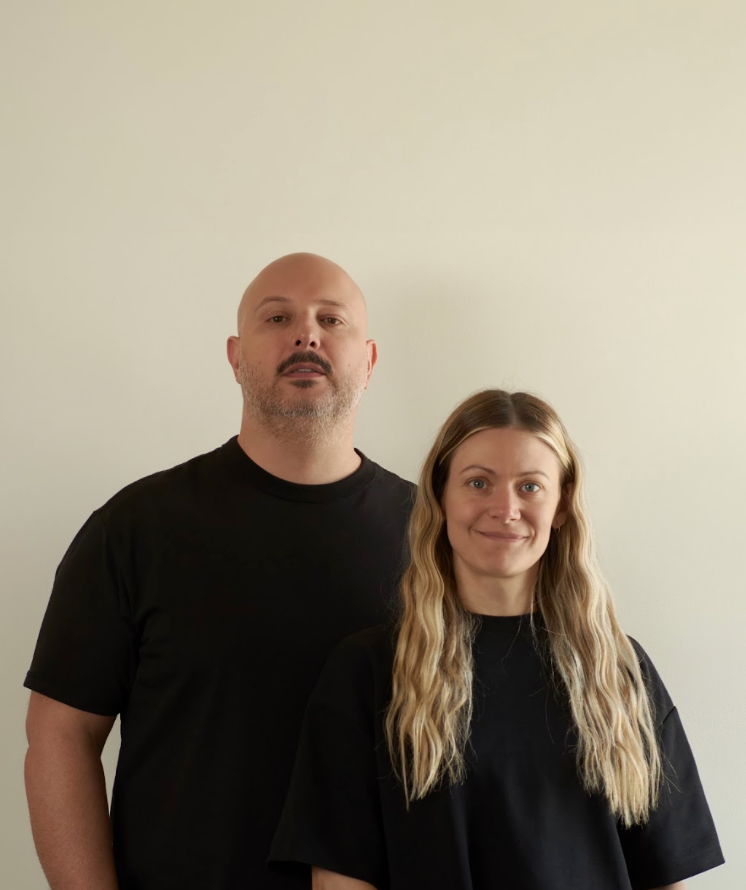
Studio Pastina was founded in Rome in 2016 by Domenico Santoro and Francesca Puddu, graduates in Industrial Design and Interior Architecture from La Sapienza University. Following years of collaboration with renowned international studios, they chose to establish their own practice, grounded in a distinct vision: design not as a response to trends, but as a constructive discipline.
Pastina conceives objects, spaces, and systems that reconcile function, imagination, and production.
The studio’s work has been exhibited at the Venice Biennale and at MAXXI, and is regularly presented at international fairs such as the Salone del Mobile, IMM Cologne, and Watches and Wonders.
Drawing on extensive experience in the furniture sector, the core of the studio’s activity today lies in creative consultancy for some of the most prominent global luxury brands, including Bulgari, Versace, and Lamborghini.
Among the numerous recognitions received are the Red Dot Design Award, German Design Award, Good Design Award, and DNA Paris Design Award, as well as a nomination for the Compasso d’Oro through the ADI Design Index 2021 selection.
Soft Monuments is Pastina’s first authorial project in collectible design: a step toward a practice removed from serial production, introducing a renewed approach to design, to the relationship with space, and to those who encounter it.