Lights In Tension
2026
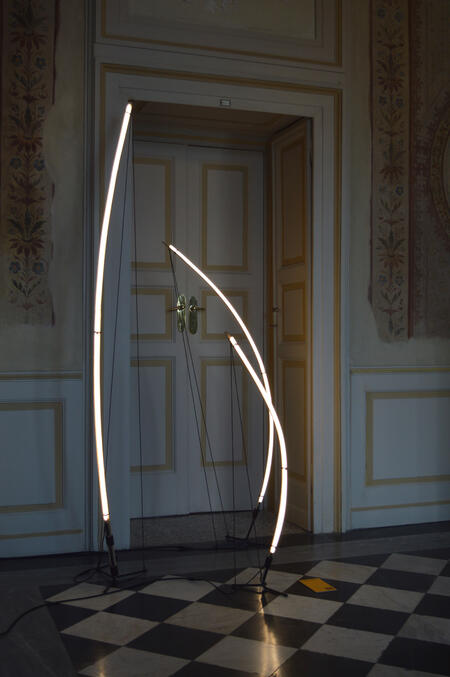
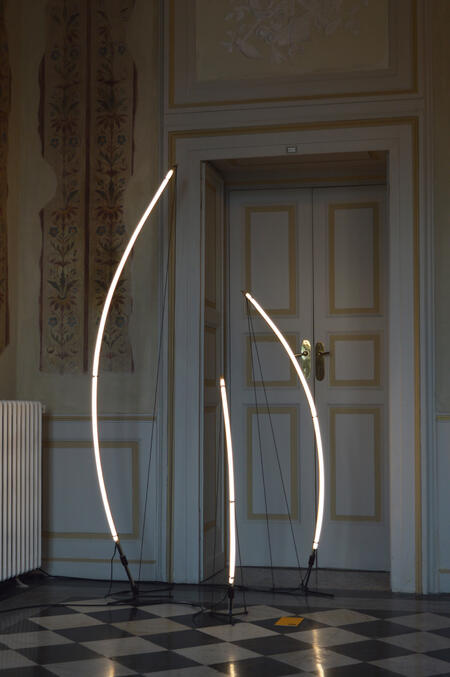
L I T is a bamboo lamp made by sectioning bamboo poles into thin strips, allowing the material’s natural flexibility to be used efficiently and without excessive mechanical intervention. This process gives shape to soft, slender, arched lamps that provide a fluid and understated illumination of space. The arch, available in three sizes, can be used individually or repeated according to spatial needs or desired effects, allowing for scenographic lighting installations.
The linear, flexible light source with a circular cross-section is housed along the concave side of the bamboo strips, running the full length of the arch.
A leather strap, fixed to the ends of the bamboo strips, holds the arch in tension. The object’s stability on the floor is ensured by a thin T-shaped base in darkened brass, also circular in section, positioned at one of the two ends depending on the user’s chosen assembly configuration.
In relation to the theme of the Border, Lights In Tension proposes an exploration of the threshold as a resource and as an opportunity for dialogue. The fragility of the objects, perceived as floating fragments within the architectural shell that contains them, generates empathetic relationships essential to a deeper understanding of things. Like subtle traces, they do not impose themselves; rather, they form intangible geometries in space—living signs in continuous becoming.

Massimo Rigaglia, born in Taormina, graduated in Architecture from the Politecnico di Milano and IUAV University of Venice. After collaborating with several architecture studios, including that of Maria Giuseppina Grasso Cannizzo, he established his own practice in Milan, where he has lived and worked since 2023.
His artistic practice draws on an evolving personal visual language and explores multiple fields of creativity, including design, spatial interventions, and experimental works, with a particular focus on lighting design. Guided by the pursuit of essential solutions, his methodical yet open-ended approach is informed by observations of social behavior and environmental dynamics, fostering an ethical approach to design.
His work embraces both industrial and artisanal modes of production, always placing the creative process at the center of each project. For Rigaglia, process is the essential means through which the deeper meaning and potential of every work can be understood.