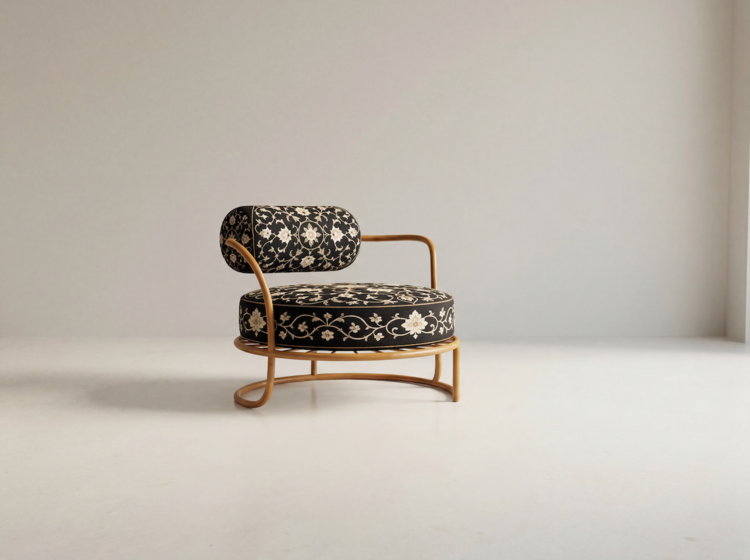
Seat in steel and fabric in velvet embroidered hand
Petit Chou
2026
Petit Chou is an indoor lounge armchair born from a sinuous, continuous line, drawn in space through a curved steel structure. The frame follows the round, soft and lightweight seat, defining its perimeter before extending upwards to form the backrest, passing through the supporting cushion.
The structure is asymmetrical, a recurring characteristic in Marta Gay’s design language. This asymmetry stems from the idea that balance does not necessarily have to coincide with symmetry, and from the search for a form of perfection that exists precisely beyond it. Absolute symmetry is, after all, an ideal that is difficult to achieve in reality: even what appears perfectly symmetrical inevitably retains differences and irregularities. Like the human body, an object can instead find harmony in its uniqueness. Petit Chou therefore embraces asymmetry as an explicit condition of its form, finding its own balance within it and bringing furniture closer to a more human dimension of living.
Petit Chou sits at the border between different design cultures, geographies and craft traditions. On one hand, it evokes a sensibility rooted in Italian design, attentive to proportion, clarity of form and continuity of line. On the other hand, it incorporates influences drawn from a journey to India. Low seating, the idea of an informal lounge, generous cushions, the richness of textiles and the visible presence of the artisan’s hand shape its visual and cultural language. The textile pattern originated from an observation of the floral motifs of the Taj Mahal, created using the Parchin Kari technique, an inlay of hard and semi-precious stones set into marble. This ornamental language, rooted in the Mughal tradition, itself originated in the Florentine tradition of pietre dure inlay. The motif thus becomes the starting point for a journey of return. A technique that originated in Italy and reached India centuries ago through artistic and cultural exchanges is now reinterpreted on textile and brought back into a contemporary Italian design object. The motif travels across time, materials and geographies: from stone to thread, from marble to fabric, from monumental architecture to the intimate, domestic scale of a seat.
The textile of Petit Chou is entirely hand-embroidered in Kashmir through a delicate needlework process on velvet, using Anchor cotton mouliné threads. Traditional Kashmiri crewel embroidery, historically worked with wool thread and an aari hook, provides a craft reference for the project and bears witness to Kashmir’s rich textile culture, shaped in part by exchanges with Central Asian, Persian and Mughal cultures. Its material richness derives from variations in the density, direction and scale of the stitches, from the combination of colours, and from the contrast between embroidered areas and sections where the velvet ground remains visible. In the context of Petit Chou, this technique was chosen not only for its aesthetic qualities, but also because it allows the textile to be entrusted to a living craft tradition, capable of transforming the design into a rich and tactile surface.
The making of Petit Chou involved several Indian partners. The textile was developed in collaboration with October, a textile studio founded by Pragya Aggarwal and based in Jammu. The pattern, designed by Marta Gay, was applied to the fabric with the support of textile designer Tanvi Jadhav and subsequently translated into hand embroidery by Bashir’s embroidery unit, through a shared process of sampling and research into colour, density, scale and texture. The chair’s structure, meanwhile, was produced by Diviana, a New Delhi-based company specialising in bespoke furniture and high-end interior solutions, combining Italian design expertise with Indian craftsmanship.
Through these collaborations, Petit Chou recognises craftsmanship as an essential part of the design process. The hand that embroiders becomes part of the object’s narrative and helps define its value. The project seeks to give visibility to a form of labour that is often central to global production, yet rarely acknowledged in its full authorship. Beyond its historical and cultural value, textile craftsmanship represents, for many women in India, a space for autonomy, expertise and entrepreneurial opportunity. Petit Chou thus emerges as a threshold: between Italy and India, between design and craftsmanship, between contemporary structure and ornamental memory. The border becomes a place of exchange, a space where distant forms, techniques and stories can meet and generate a new possibility for inhabiting space.

Marta Gay is a young Italian-Swiss designer with a background in art history, curatorial practice, and design. Her work originated from an interest in exhibition spaces and the dialogue between artworks, architecture, and audiences. From imagining environments for art, her research has evolved toward creating objects that transform space, reflecting on craftsmanship and making as forms of knowledge and artistic expression.
Through Mani d'Arte, she explored the relationship between art, craft techniques, and the transmission of manual knowledge, with a particular focus on textile production by women artisans in India. As a designer, she began by creating bespoke pieces in collaboration with Garibaldi Architects. During Salone del Mobile, she presented Cytrus Biancamaria, where she made her debut as a designer while shaping the exhibition's spatial identity.
Her practice operates at the intersection of art and design. She develops a relational approach to design that connects space with those who inhabit it, weaving together contemporary design languages and craft traditions from diverse cultural contexts. In doing so, she transforms the boundaries between techniques, cultures, and forms into spaces of exchange.