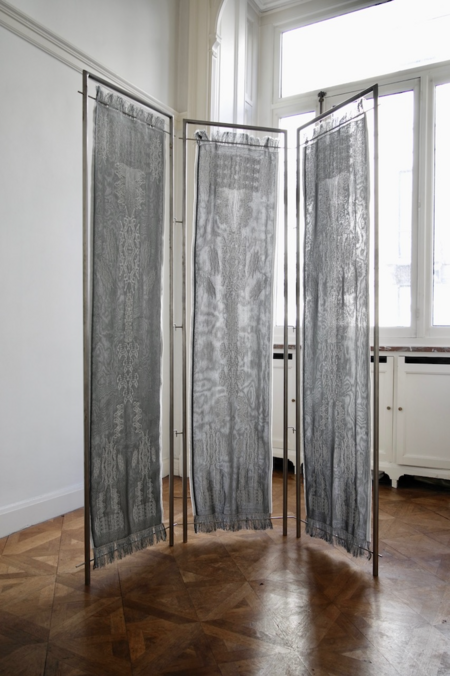
Room divider in cotton, linen, reflective yarn, synthetic yarn blend (technological yarn)
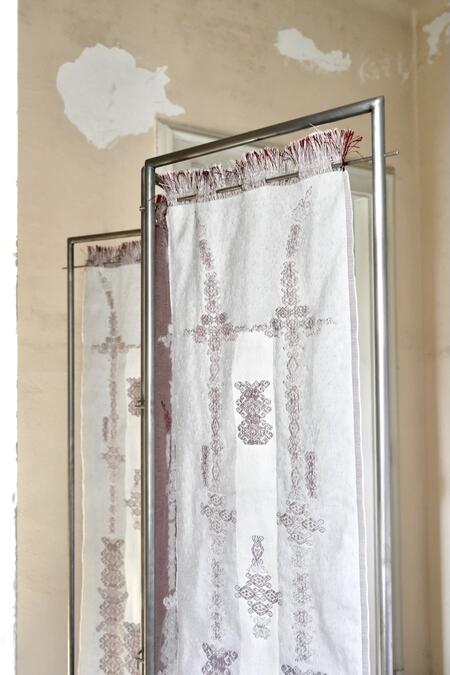
To Read A Pattern
2026
What happens to a non-western craft when integrated into European production standards?
Guided by this question, ‘To Read a Pattern’ explores how Laotian patterns
might persist in new geographical, technological and cultural contexts.
In Laos, weaving is a living tradition — patterns are continually created and traditionally passed down from mother to daughter, to be used in a domestic context or on traditional clothing.
Orientalist depictions and cultural biases have led to very little authentic or contemporary representation of Laotian textiles in Western spaces. Yet in Laos, the craft remains
largely unchanged by its colonial past, being still used in a domestic context, creating a dissonance in how the patterns are read between cultures. Could an alternative perspective emerge from this gap?
Using patterns collected from field research in Laos and the industrial production methods at
her disposal at the TextielMuseum in Tilburg (NL), in trying to accommodate the artisanal craft to an industrial loom, Marie Vilay developed a new generation of patterns.
By exploring how tradition might live on through transformation, new generations of patterns,
embedded on translucent banners (a reference to a traditional Lao way of pattern display), come together in a membrane-like cloth that creates a space for an alternative mode of representation and engagement with the Laotian patterns, that aims to perpetuate the Lao weavers’ rich tradition in a different context.
Growing up surrounded by traditional Lao textile patterns in a domestic context (on a table cloth, on the sofa or on traditional clothing), this project started with the perception that a same object, that seems familiar to some, might feel foreign to others.
The newly created cloth aims to reintroduce the new textile patterns into a domestic context, shifting the perspective on them from something foreign, to something more omnipresent/familiar. The cloth acts as a membrane that connects viewers from the community it emanates from and onlookers from the outside, with the aim of reconciling contrasting/opposing perspectives.
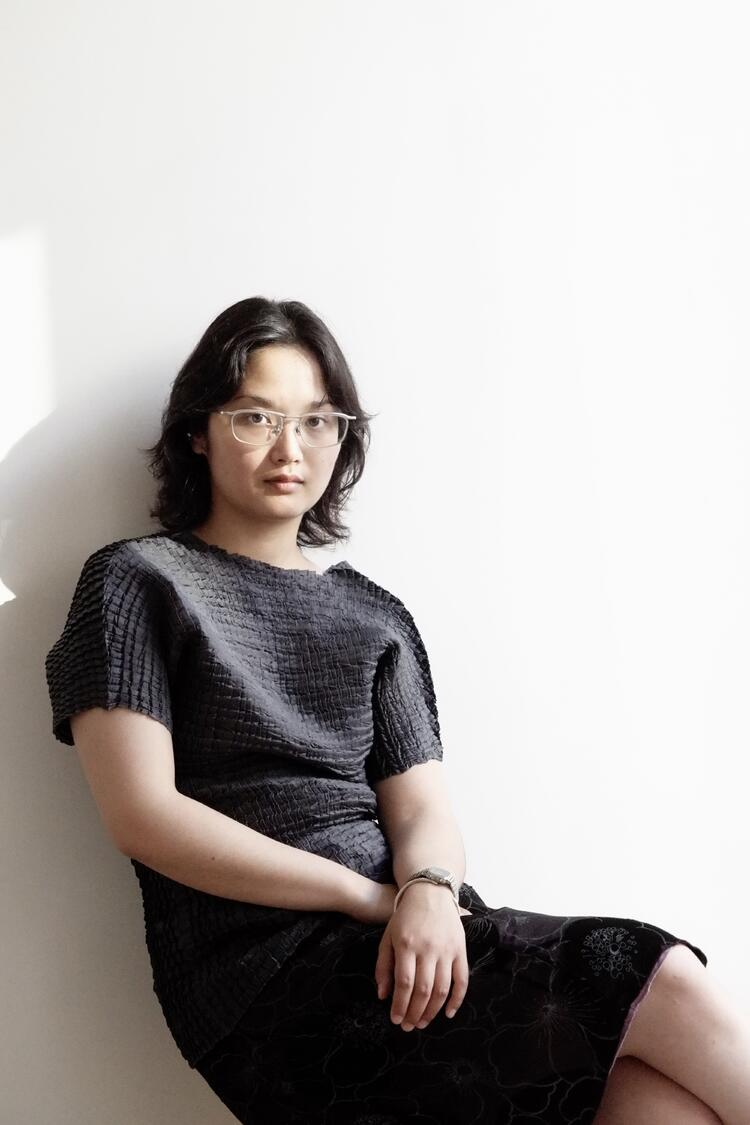
Marie Vilay is an artist/designer, weaving themes of migration and decoloniality into her work. Born in Luxembourg, to a mother belonging to the Laotian diaspora and a Luxembourgish father, she graduated from the Design Academy Eindhoven in the Netherlands and now resides in Brussels.
Analyzing aspects that connect different textile practices, her work takes the form of textile pieces and installations that use their geographical and cultural context as a conceptual basis to explore questions on heritage, cultural identity, and belonging.
Informed by the history of displacement of her family and the experience of her weaving
apprenticeship at the Houey Hong vocational center in Vientiane, in Laos, she has been developing a series of work exploring how Lao weaving traditions might be continued within the European production system she’s a part of.
By studying how textile craftsmanship itself is passed on within the culture of her ancestors, she researched craft and technology through the lens of someone attached to the Lao diaspora, letting a space emerge for complexity and dialogue.