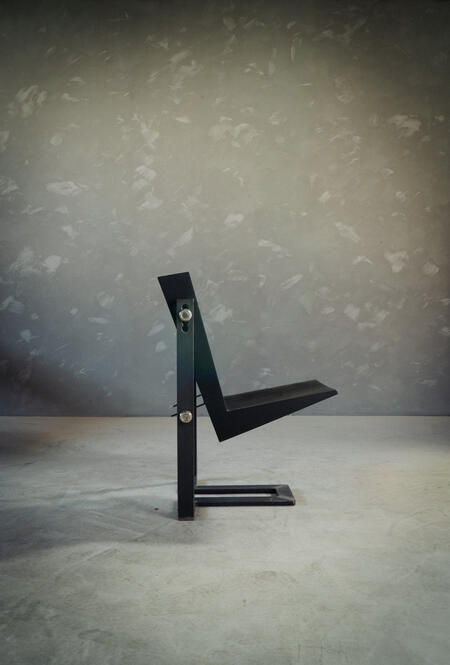
Chair in steel and MDF. Console in olive wood and steel.
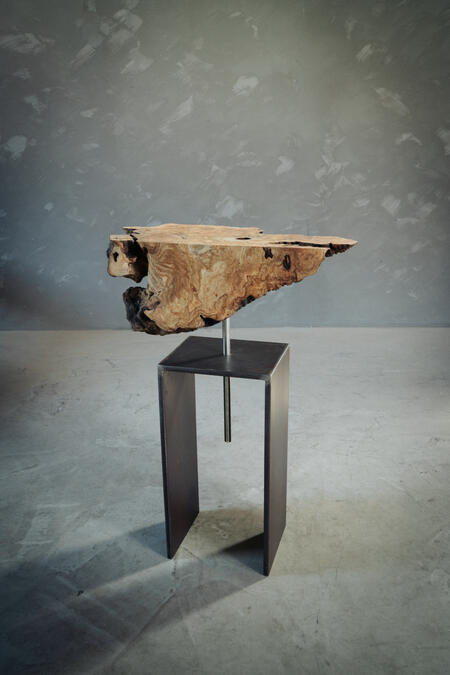
Olive Tree Console & The Black Chair
2026
Every new piece I create is born from the dialogue between contrasts.
For a contrast to be meaningful, each material must possess its own inherent strength and identity. It must retain its internal energy and remain true to its natural boundaries. Only when I recognize this quality in a block of marble, a piece of olive wood, or a solid steel structure do I begin to combine them into a functional object, such as a console.
For the console, I chose an extraordinary piece of olive wood. While not particularly large, it possesses an almost monumental presence. Its energy seems to radiate in every direction. The inverted U-shaped steel base encloses a volume of empty space between its legs. It is this very void that lifts the wooden block, projecting it upward and giving it a sense of elevation.
This console is defined by a series of contrasts. The wood is at once raw and organic, yet smooth and carefully polished. The weight and rigor of the steel are set against the warmth of the wood and the lightness of the empty space. Together, these opposing forces create a balanced composition in which every element retains its own essence.
Concerning the chair, in my surge for strong contrasts in a piece of furniture I brought two materials together that are quite opposed to each other: massive steel and MDF (medium-density fibreboard)
The very strong steel frame is so stiff that it doesn’t show any flexibility, although the weight of the person is trying to pull it down.
MDF is normally a soft and inferior material, but by gluing several L shaped forms together it becomes quite solid. So, I created an abstract volume in a deep black colour (which is not a patina but mass-dyed).
Because the seat is only fixed from both sides, I could avoid the need of standard legs. This gives the seat a feel of floating.
Here comes the idea of border into play: every single material or volume has its own boundary. The steel base brings the horizontal contact with the Earth upwards into a vertical movement. And the MDF volume brings this vertical energy back into the horizontal plane. In-between these two horizontal movements is only empty space with no boundaries at all. Infinite energy is the result.
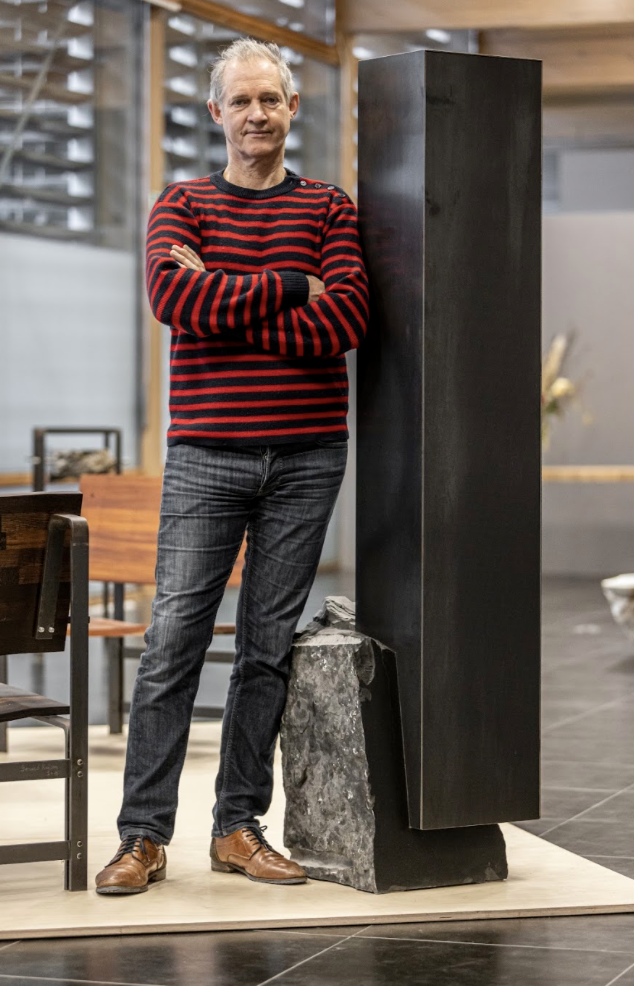
Since the early 1980s, designer and artist Gerard Kuijpers has developed a distinctive practice in which steel and marble have remained his primary materials. This unique approach quickly established his reputation and earned him international recognition, affirming the intuitive experimentation and relentless exploration that had shaped his work from the very beginning. That early success confirmed his artistic vocation, while the curiosity and enthusiasm that first inspired him continue to fuel an ever-evolving body of work—one driven above all by a desire to explore and express what continues to fascinate him.