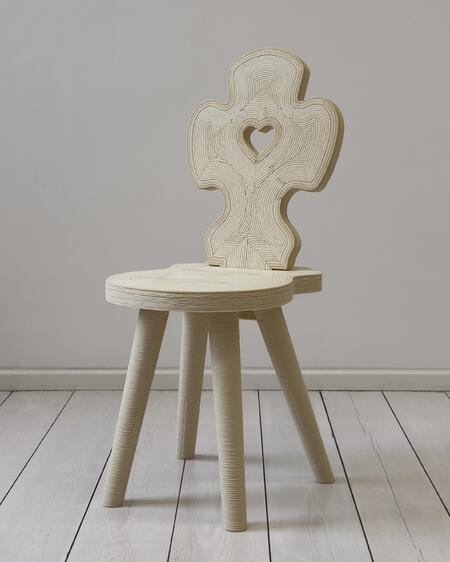
Chairs in PLA
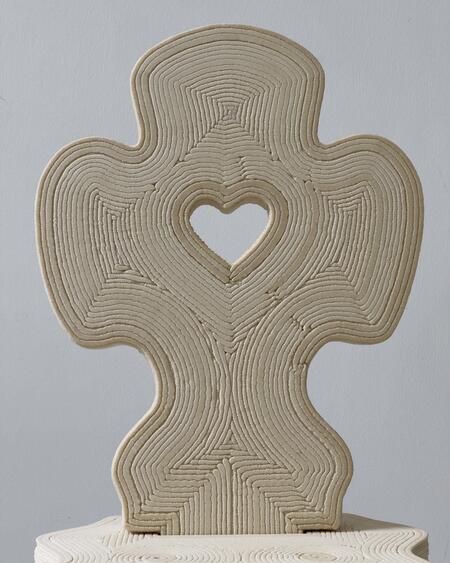
Heimatlos Chair
2026
Mass production is increasingly displacing traditional craftsmanship—and it is precisely at this intersection that em ef studio positions its work.
The project takes as its point of departure a piece of furniture with a history spanning more than 400 years: the board chair. As one of the earliest chairs to feature a backrest, it originated within rural communities. More than a functional seating object, the chair represents a historical artifact that embodies centuries of social change, craftsmanship, and cultural values. It stands for permanence, accumulated knowledge, and the slow evolution of design.
The studio examines this object through the lens of a contemporary technology: 3D printing. This technology represents accelerated design processes, digital seriality, and a distinctly modern aesthetic.
The result is a field of tension—a boundary that not only separates but also connects past and future, craftsmanship and technology. The work explores this intermediate space and raises questions about what is lost, what is preserved, and what new possibilities emerge when historical craft traditions encounter digital technologies.
It is precisely within this ambiguity that the project's relevance lies. The boundary is not understood as an obstacle but as a productive space for dialogue. The transition between craftsmanship and technology is not staged as a conflict, but rather as an opportunity to reflect on the future of making and designing. The work invites viewers to critically reconsider prevailing notions of progress and to re-evaluate the significance of materiality, time, and human labor.
A particularly intriguing aspect of the project is that the machines proved to be far more error-prone and imprecise than initially expected. The machines do not think independently; they operate solely on the information provided to them and cannot autonomously respond to unforeseen circumstances. Data must be meticulously prepared, adjusted, and fed into the system. Temperature fluctuations and changes in material properties can significantly affect the printing process. Human intervention remains necessary throughout production, requiring manual adjustments and continuous oversight.
As a result, despite being machine-made, each object becomes unique. The boundary between craftsmanship and digital technology begins to dissolve, revealing an unexpected convergence in which both rely on human knowledge, experience, and adaptation.
The chair is made from a biocomposite granulate consisting of 20% carefully selected wood-based cellulose fibres sourced from PEFC-certified forests and 80% virgin polylactic acid (PLA). The bio-based material is sustainable and recyclable, combining the natural qualities of wood with those of bio-based plastic in a new material.
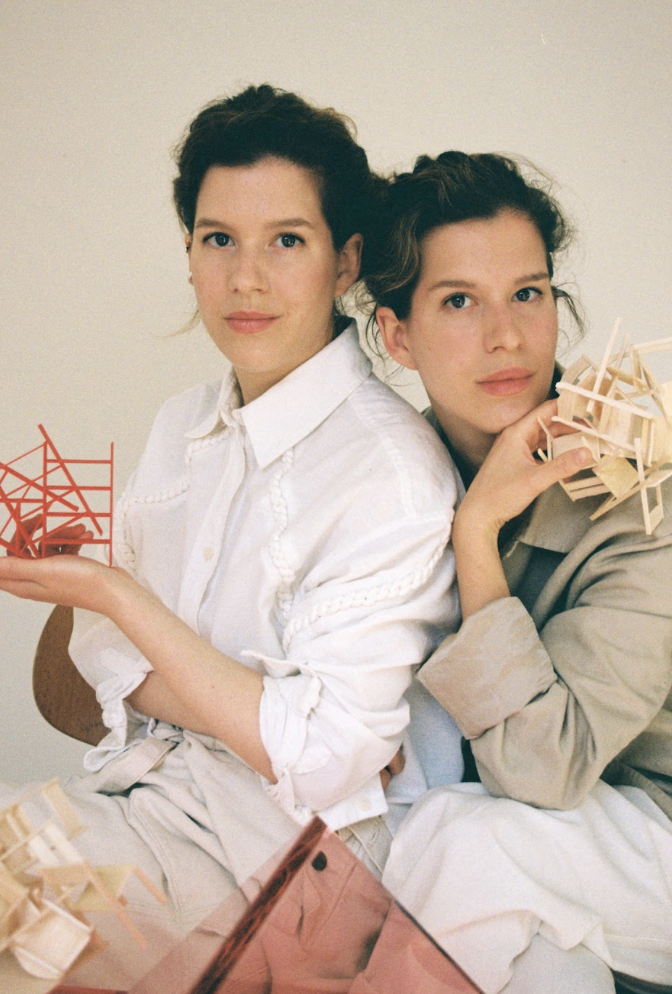
Two sisters. Two cities. One studio.
em ef – that's Marie and Feline: twins, designers, artists, and keen observers of everyday life. Their perspective: playful yet thoughtful. Their medium: objects, models, installations.
Born in Munich and raised in Vienna, they studied film in Berlin and worked there as a duo of directors.
Drawing became their refuge – from this emerged „Die Genießer“: illustrations, a book and a column in the Tagesspiegel newspaper.
In 2022, they founded em ef studio – the leap from 2D to 3D. Their studio is a space for reflection, a stage, and a workshop all in one. Here, they create objects that appear playful but pose social questions: movement, balance, and contemplation. Humor is their method – provocation rather than instruction.
Despite the distance – Marie in Frankfurt, Feline in Berlin – they work closely together. Different working methods intertwine: analog thinking meets digital augmentation. The goal is a reduced, but pointed design language.