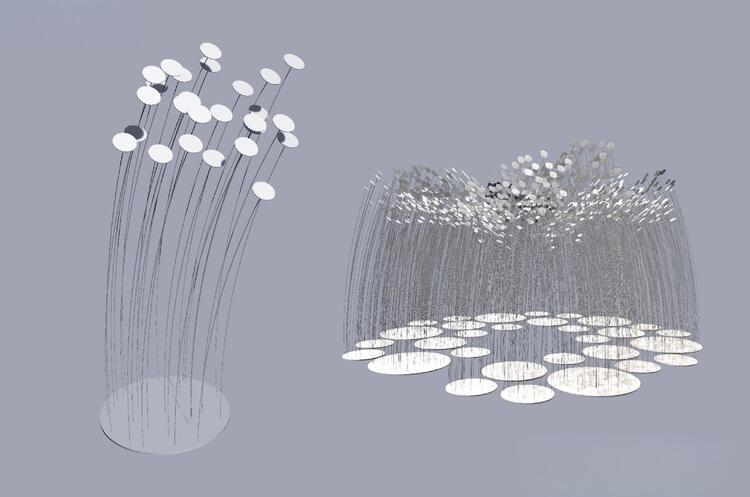
Steel installation
Zhamanak
2025
Zhamanak, the Armenian word for “time”, is an installation that explores the concept of the border as a dynamic, unstable, and perceptual condition. Moving beyond the notion of the boundary as a line of separation, the work reimagines it as a space of relationship.
Here, the boundary is not understood as a defined edge, but rather as an emergent phenomenon that unfolds over time through the interaction of matter, light, and environment.
The installation consists of a constellation of slender spring-steel rods, each culminating in a small reflective element.
Minimal and ethereal in appearance, the structure functions as a sensitive device designed to activate in direct response to sunlight.
Natural light itself—variable, shifting, never constant—becomes the true generative force of the installation.
Throughout the day, the changing angle of the sun radically transforms the perception of the work. Light is captured, reflected, and fragmented into a multiplicity of luminous trajectories that expand into the surrounding space.
This is not merely a decorative effect, but an ongoing process. The installation continuously activates and redefines itself in response to the movement of the sun, making time a structural component of the work.
The image is never stable, nor singular.
Zhamanak exists as a temporal phenomenon: a field of luminous variations that continuously construct and dissolve new perceptual configurations.
In this sense, the boundary manifests itself as an event—a shifting threshold that takes shape through the interference between light and matter.
When placed near water, this perceptual device becomes further amplified.
The reflective surface introduces a second layer of complexity, multiplying and distorting the light rays. Reflections split, overlap, and disperse, generating a condition of visual ambiguity in which distinctions between depth and surface, source and reflection, begin to dissolve.
The boundary thus becomes fluid, mobile, and continuously redefined.
The flexibility of the spring-steel rods, responsive even to the slightest movement of air, further destabilises the system.
Every micro-movement alters the orientation of the reflective elements and, consequently, the trajectory of the sunlight itself, producing a constant transformation of the work.
The installation does not merely occupy space; it activates it, transforming it into a field of interaction between visible and invisible forces.
Zhamanak therefore inhabits a liminal condition: between matter and light, stability and change, perception and mental construction.
It is a place where the boundary is never given, but continuously generated through experience.
In this perspective, the work constructs an open condition rather than a finished form.
The border is no longer something to be crossed, but something to be inhabited: an unstable, temporal, and relational territory that exists only through the ongoing negotiation between observer, light, and environment.
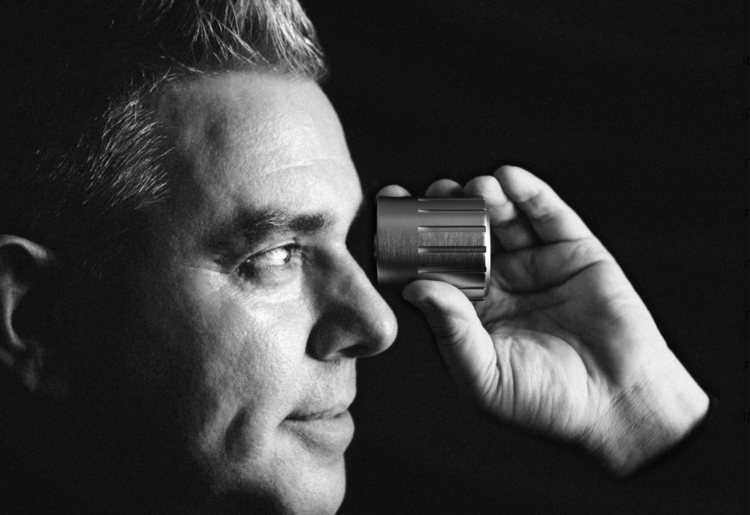
Dodo Arslan is an Italo-Armenian Designer, recognized by Taschen among the 90 protagonists of world design, collected in the volume DesignNow.
Parallel to his work as a light, product, and graphic designer, for more than twenty-five years Arslan has been developing an intense formal and material research in the field of ArtDesign.
With an international career spanning Europe, the United States, and South America, Arslan has been able to give shape to profound values – identity, excellence, memory, culture – through trophies and sculptures that celebrate extraordinary personalities and institutions.
He is the author of the Italic Award trophy, the recognition awarded to outstanding Italian personalities in America by the Italy-America Chamber of Commerce (IACCSE).
On the commission of the Foundation of the Centenary 1873 of the Swiss Italian Bank, he conceived the Incontro trophy, awarded to Italian and Swiss personalities who have succeeded in building cultural bridges between Italy and Switzerland.
On the occasion of the Centenary of the Italian Air Force, he sculpted Níkē, a work that expresses the glory of achievements and triumph, inspired by the famous 'Goddess of Victory.' His plastic, powerful, and poetic language is also expressed in collectible pieces such as Nove, cast in bronze by Fonderia Artistica Battaglia; Glace, in acrylic glass, launched on the occasion of ArtBasel/DesignMiami; the seat Otto in carbon fiber, which entered the Permanent Collection of Italian Design and was exhibited on a worldwide tour starting from the Triennale di Milano.
His creations, auctioned by Pierre Bergé & Associés in Brussels, have entered the collectible ArtDesign circuit.