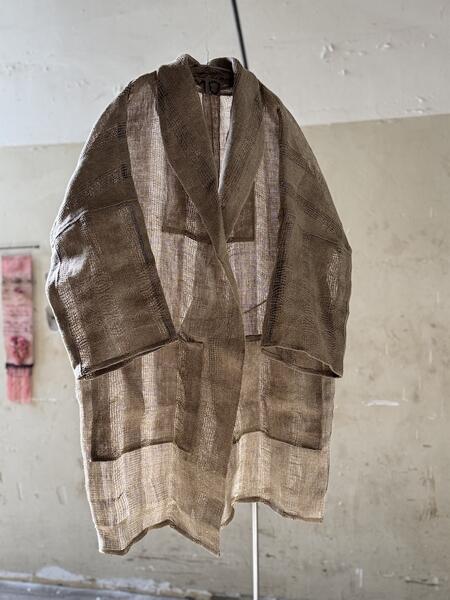
Objects in linen, wool and cotton yarn
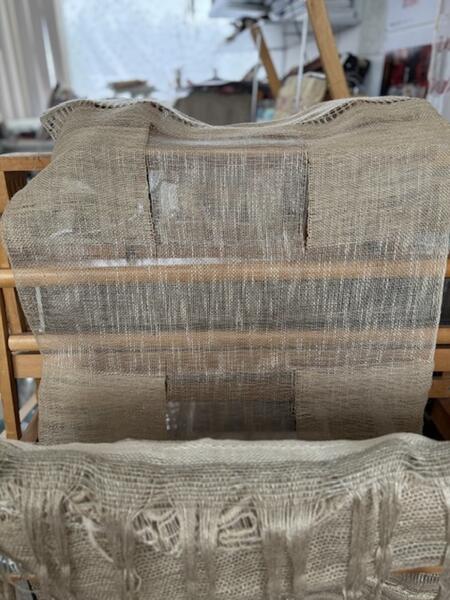
Porous Boundaries
2026
This installation positions Munsel’s work as a meditation on the contemporary condition of borders. In a time marked by migration, environmental instability, and contested territories, the installation refuses the idea of confinement as closure. Instead, it proposes the boundary as a permeable interface—a site of encounter, tension, and transformation.
Visitors do not observe the works from a distance; they inhabit them. Movement becomes a form of participation, a negotiation of space that echoes the broader social and political dynamics of crossing, waiting, and belonging. The textiles, in their quiet materiality, suggest that boundaries are not fixed lines but living processes, continuously woven and unwoven.
A handwoven lace tapestries and garments as an immersive, site responsive presentation transforms textile into a spatial and political experience of Border. Rather than displaying the pieces as static objects, the exhibition unfolds as a walkable threshold, where visitors move through layers of woven boundaries—never fully inside, never entirely outside.
The presentation is conceived as a sequence of semi-transparent partitions suspended within a historic interior. Munsel’s large woven panels hang freely, arranged in parallel yet slightly offset planes.
The suspended handwoven garment pieces occupy a central position, hovering at eye level like a silent presence—neither worn nor abandoned, but waiting. They become a threshold-objects, suggesting the body as both protected and exposed, held within a fragile architecture of threads.
Natural light is essential. As daylight shifts, it filters through the open weaves, projecting shadows that redraw the boundaries across walls and floors. The textiles thus extend beyond themselves, creating ephemeral architectures of light.
Introducing her newly interpreted lace works —fragile, decaying, uneven—in contrast with the structural regularity of the warp threads, Munsel emphasizes the tension between order and disruption. These elements evoke landscapes carried into the interior, suggesting that boundaries are never purely cultural or political, but also ecological.
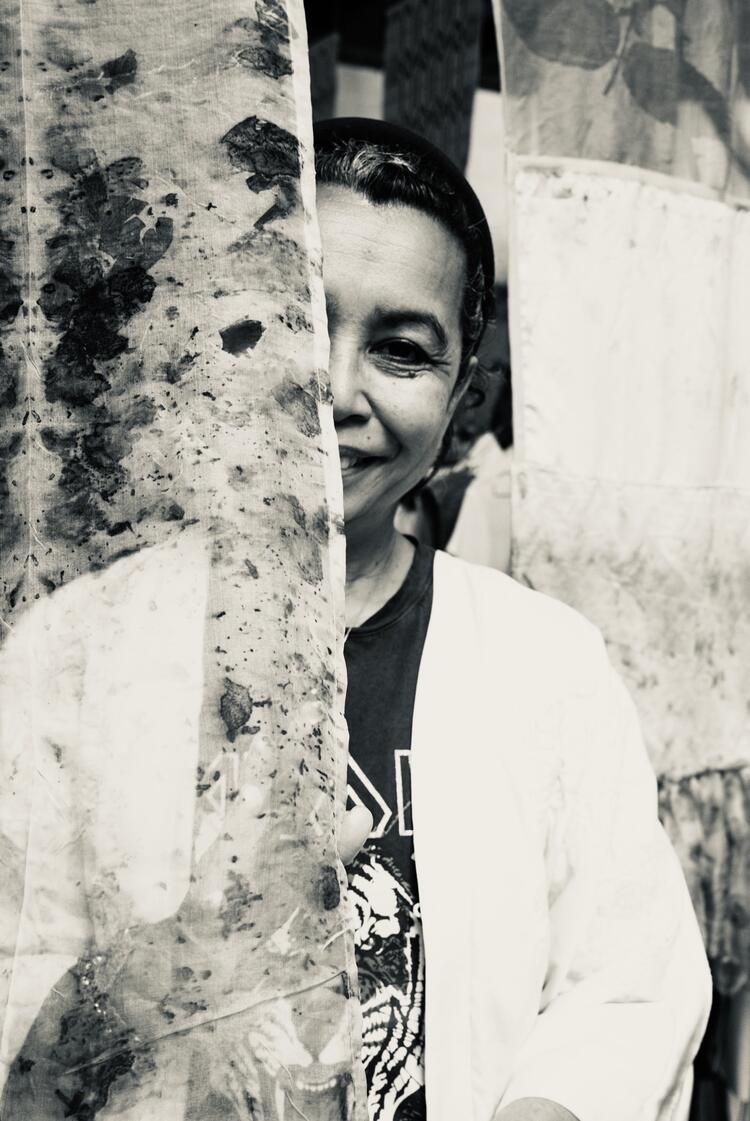
Barbara Munsel was trained as a designer at The Royal Academy of Arts in The Hague (NL) now is a textile artist and designer whose work centres on the conceptual and material possibilities of fabric. Working primarily with fabric, she approaches textile as a palimpsest—an active surface in which traces of previous gestures, histories, and meanings remain embedded.
Her practice is characterized by a distinctive visual language of layered and fragmented compositions, through which she examines themes of identity, memory, and transformation.
Drawing on a background that informs both her conceptual framework and material approach, Munsel treats textile as a dynamic medium rather than a static surface. Her works often engage with processes of deconstruction and reconstruction, reflecting a broader interest in how meaning is formed, disrupted, and rearticulated over time.
Positioned within contemporary textile art, Munsel’s practice bridges the fields of design and fine art. Her work emphasizes process, tactility, and the temporal nature of materials, contributing to ongoing discussions around textile as a critical and reflective medium.