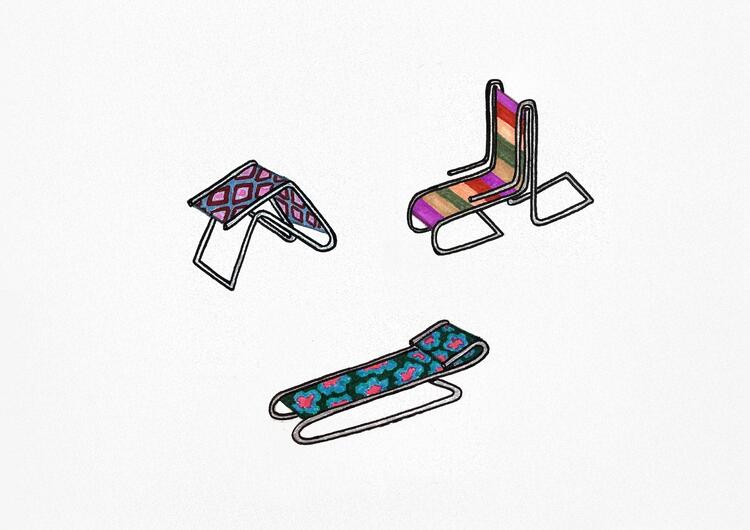
Chairs in steel and fabric
Matrici
2026
Matrici is Anticamera's first furniture project and stems from a reflection on the boundary as a generative principle. Before it separates, every border establishes a measure: it defines a field, guides the creative gesture and, by introducing tension, opens the possibility of transformation.
From this intuition emerges a shared matrix: a tubular metal structure that, through three different configurations, gives rise to a stool, an armchair and a chaise longue. The boundary is inscribed within the very construction of the object. It runs along the profile of the seat, defines its perimeter, and holds the form just enough for the textile to complete it. It is the covering, in fact, that transforms the frame into a usable surface: not a finish applied afterwards, but the material that tensions the structure, alters its presence and shapes its character each time.
The three seating pieces are thus developed through three different textile typologies — indoor, outdoor and archive — each corresponding to a different way of inhabiting the boundary.
In the indoor version, the structure is brought into a more domestic dimension, intimate and close to the body. Made from natural yarns, the textiles feature abstract jacquard patterns rich in texture and materiality. Their presence introduces a warm, enveloping quality, creating a sensory contrast with the metal tubular frame. The supporting structure remains visible, yet the weave and tactile quality of the textile bring it into a more sensorial dimension: the boundary no longer appears as a rigid edge, but becomes a surface of support, a point of contact between object and inhabited space.
The outdoor version opens the seat to a more exposed condition. Technical yarns provide functionality while creating a three-dimensional woven appearance capable of engaging with the outdoor environment without sacrificing formal quality. The textile covering is called upon to confront light, air, humidity and long-term exposure to the elements. At the same time, it subtly evokes the imagery of deckchairs and hammocks — a world of relaxation, suspension and intimacy. In this interpretation, the boundary does not protect by isolating; rather, it allows the object to engage with a more unstable, shared and permeable environment.
With the archive version, the project shifts the boundary into the dimension of time. Printed textiles featuring patterns drawn from the historic textile archive of the Gentili Mosconi Foundation cross the threshold between preservation and use, memory and presence. This valuable collaboration brings to light rare designs that testify to the heritage of the Como textile district, founded on the synergy between artistic sensitivity, compositional refinement and technical mastery. The fabric is not treated as an artefact to be preserved at a distance, but as a living material still capable of entering into dialogue with a contemporary form, carrying the time of its origin into the seat itself.
The decision to work with three different types of clothing is not merely functional. Rather, it creates a system of variations around a common form. The metal matrix remains constant, while the textile transforms the identity of the object, the way it inhabits space, and the relationship it establishes with its user. Each seat thus becomes an open form, capable of adapting and evolving without losing its structural integrity.
This tension between permanence and transformation also reflects Anticamera's working method. Founded in Como as a non-profit cultural organisation, Anticamera operates at the intersection of design, craftsmanship and artistic research, transforming ideas, materials and knowledge into objects with a poetic function.
The project therefore does not emerge as an isolated authorial gesture, but rather as a collective process: it was developed with the support of Antonio Cao, with the metal structure produced by Fratelli Broggi, while the textiles come from Luigi Verga S.p.A. and the Gentili Mosconi Foundation. These collaborations root the project in the local area and its material culture. Throughout this process, the dialogue with the local craft and manufacturing fabric is further supported by the collaboration with Confartigianato Imprese Como, Anticamera’s main partner and a key interlocutor in building a network of expertise centred on making and craftsmanship.
In this sense, Matrices is also a boundary project in its methodology: between art and design, industry and craftsmanship, function and imagination, object and narrative. The seating pieces do not simply occupy space; they question it. They do not define a finished form, but a field of possibilities. The border, no longer a limit, becomes a living structure: that which allows matter to take form, memory to circulate once again, and the object to become a place of relationship.
The project is supported by the Fondazione Provinciale della Comunità Comasca.
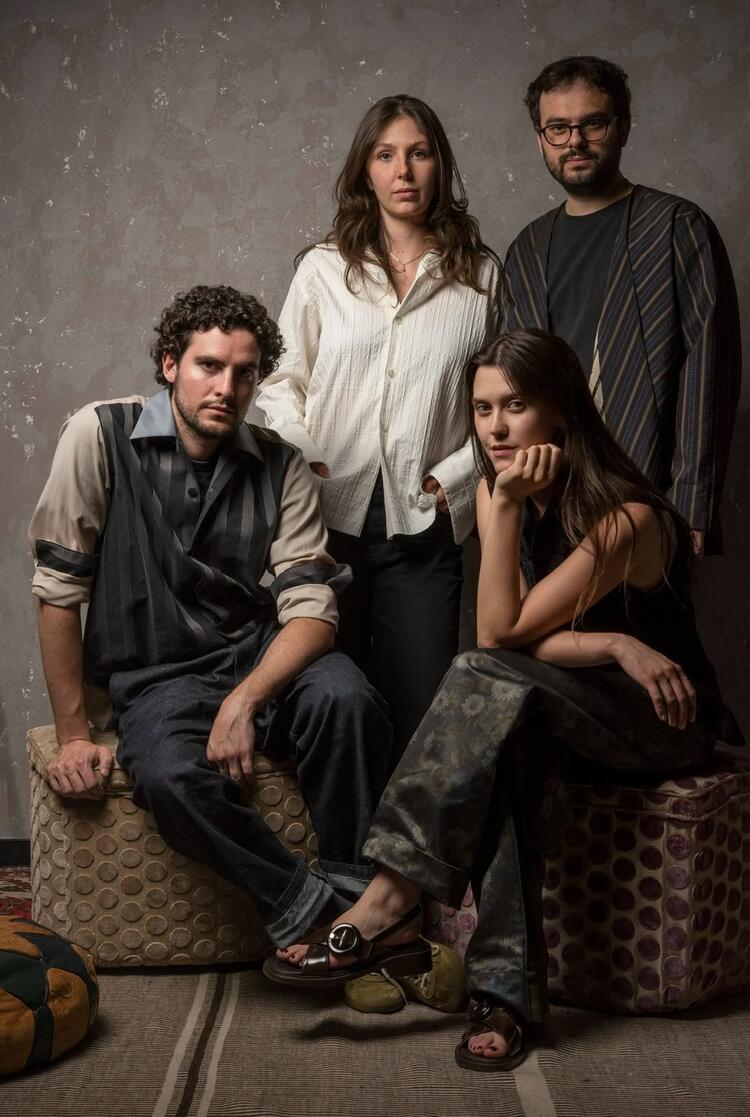
Anticamera is a non-profit cultural organisation based in Como, founded with the aim of fostering dialogue between design, craftsmanship, and artistic research. Conceived as a laboratory of ideas and practices, Anticamera transforms concepts into “objects with a poetic function”: artefacts in which aesthetic sensitivity intertwines with social engagement and material regeneration. Within its Atelier, space becomes a hinge between tradition and experimentation, welcoming diverse materials and forms of knowledge and bringing them together in new forms of shared expression.