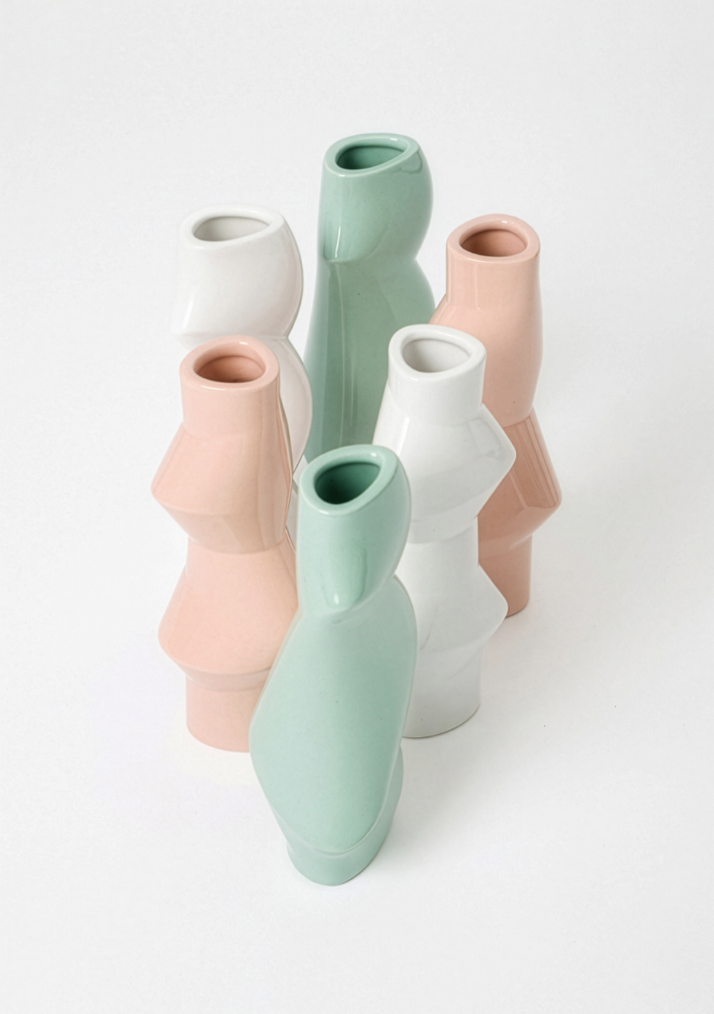
Vases in ceramic
Rheinvasen
2026
This series refers to the Rhine, which both divides and connects. On the one hand, the river separates the cities of Cologne and Düsseldorf into two parts each – east and west. On the other hand, the water connects the two major cities in North Rhine-Westphalia. In contrast, the bridges spanning the river create a connection between the separated city districts while simultaneously giving each city its own unique identity that distinguishes it from the other.
The design of the two Rheinvasen is based on the distinctive profiles of the Rhine bridges in Cologne and Düsseldorf. The form emerges from the dynamic interplay of these characteristic silhouettes, interpreting, as it were, the water and traffic flow above and below the bridges.
The Cologne Rheinvase refers to the Hohenzollern Bridge, whose striking steel structure dominates the cityscape directly adjacent to the cathedral; the Mühlheim Bridge, a classic cable-stayed bridge that stands out for its delicate form; and the Severins Bridge, which epitomizes the functional civil engineering of the postwar era.
The Theodor-Heuss-Brücke in Düsseldorf, built in the late 1950s as the world’s largest cable-stayed bridge at the time, as well as the striking Rheinkniebrücke and the Flughafenbrücke with its V-shaped pylons, served as inspiration for the Düsseldorf Rheinvase.
The colour scheme of the Cologne Rheinvase is dedicated to the “Cologne Bridge Green,” which was introduced in 1929 at the instigation of the then-mayor and later German Chancellor Konrad Adenauer.
Drawing on the regionally celebrated rivalry between the two major cities in the Rhineland, the Düsseldorf Rheinvase is designed in a pale red as a complementary contrast.

SPADE is an interdisciplinary design studio, based in Cologne and Milan. The studio was founded by Marco Hemmerling as a platform for research-driven and experimental spatial design. Our work ranges from architecture to interior and product design as well as speculative artefacts and installations.
Marco is a coopted member of the Association of German Architects and of the German Association of Craftsmen. In 2025 he has been awarded a scholarship of the German Academy in Rome at Casa Baldi, considered one of the most important awards for outstanding artists in the fields of visual arts, architecture, literature and music.
He engages also in teaching and research as Professor of Computational Design in Architecture at Cologne University of Applied Sciences and holds a Visiting Professorship at Politecnico di Milano. Previously he was Professor at the Detmold School of Design and Director of the post-graduate Master program Computational Design and Construction at the East-Westphalia University of Applied Sciences.