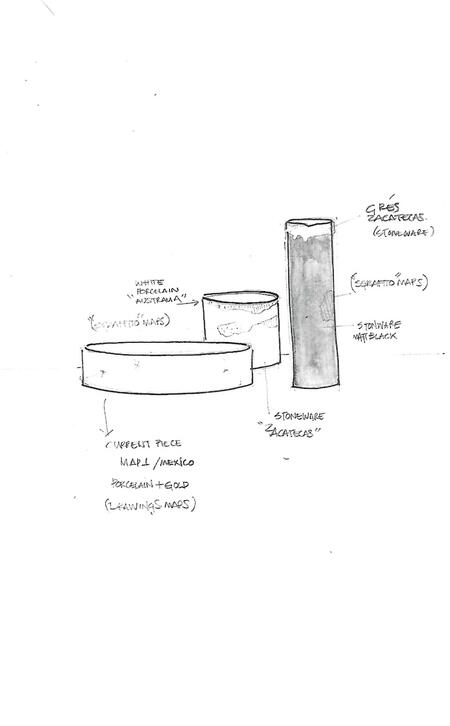
Vases in australian porcelain and gold lustre
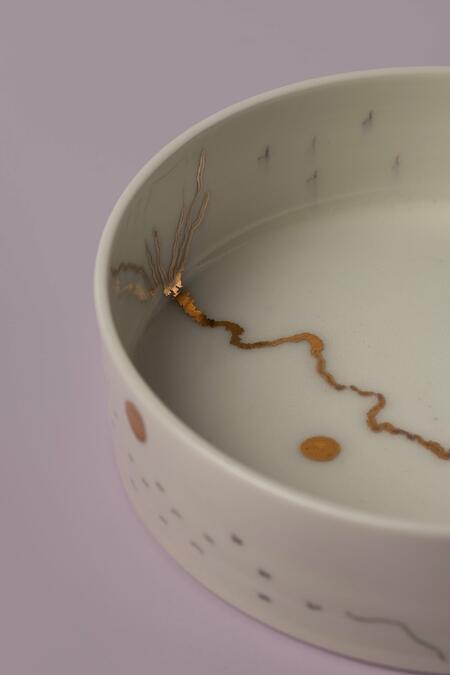
Map I/2026 – México
2025/2026
In this work, the notion of the border is radically reimagined. Rather than functioning as a line of separation, it becomes a generative, relational and evolving condition. The border is no longer understood as a limit between distinct entities, but as a site where meaning emerges—a space in which territory is not predefined, but continuously brought into being.
The ceramic surface does not present a conventional map. Instead, it unfolds as a constellation of marks that operate as catalysts. Lines, dots and clusters do not depict a landscape; they evoke its latent possibility. Here, the line relinquishes its traditional role as a boundary and becomes a generative force: it does not enclose but creates relationships, establishes connections and opens new spaces.
The border thus appears as a liminal threshold, where seemingly opposing conditions—interior and exterior, memory and imagination, the visible and the invisible—interpenetrate without ever resolving into fixed opposites.
This instability takes spatial form through archipelagic configurations: non-hierarchical systems without a centre, where each element exists only through its relationship with the others. The border no longer defines a territory but weaves a network. It connects rather than separates, making transition and exchange possible.
The work also proposes a different understanding of time. Initially conceived as an archive of lived experience—a repository of personal traces—it gradually evolved into an oracular device. The border shifts from a spatial condition to a temporal one, becoming a threshold between what has been and what might yet emerge. Time unfolds not as a linear sequence but as an epiphanic dimension in which the possible becomes present.
The materiality of porcelain reinforces this transformation. Formed through successive stages of change, the ceramic process embodies an almost alchemical quality: matter is continually transformed, stabilising without ever losing the memory of its becoming. Every surface becomes a condensation of forces, every mark an active path inviting exploration and interpretation.
The viewer is not confronted with a representation but invited into an experience of passage. The border is not simply observed but enacted. It is through the viewer's gaze and interpretative engagement that the territory comes into existence. Map I/2026 – México does not describe a place; it generates one, existing only through the act of its activation.
The work is constructed from Australian porcelain, wheel-thrown and fired in an electric kiln in an oxidising atmosphere, first at 980°C and then at 1250°C. After the first firing, the drawings were applied in two stages: first, freehand with ceramic pencils (metal oxides), followed by gold lustre and a transparent glaze, before a final third firing.
Map I/2026 – México belongs to Personal Maps, a series of ceramic works inspired by rites of passage, dreams, imagined landscapes, unexplored territories, plural archipelagos and endless journeys. Each piece is a unique personal map, created through an unrepeatable creative process. Personal Maps forms part of Extraordinaria, Geogrāfica's symbolic and contemplative collection.
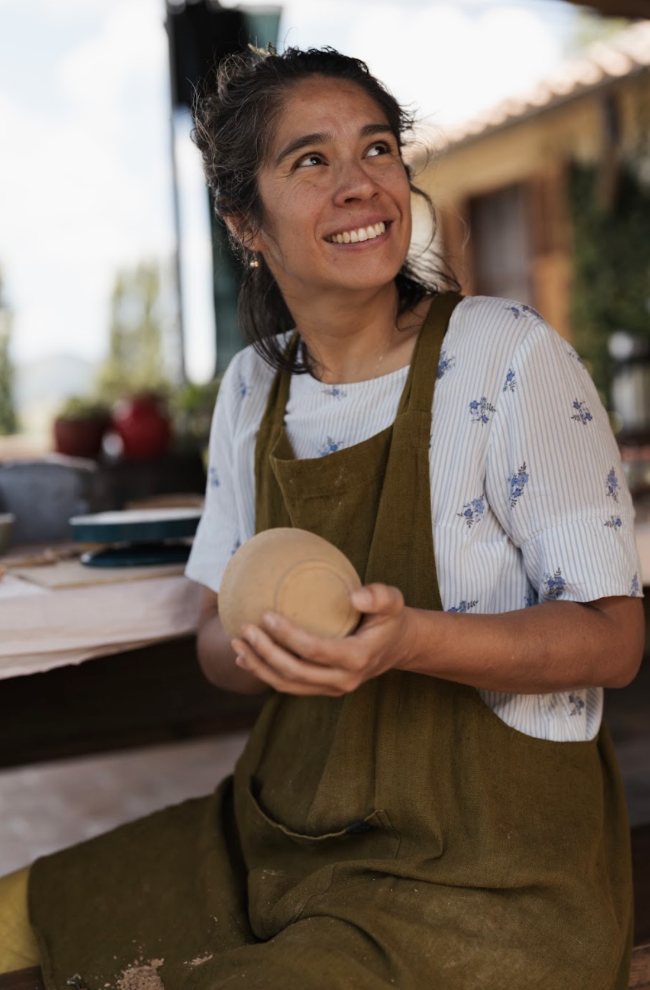
I am a Mexican designer and ceramic artist whose practice explores the relationship between design and place, as well as the documentation and interpretation of individual and collective creative processes.
Before I turned twenty-five, I realized that my creative path lay in working with clay. In its permeability, receptiveness and elasticity, I found a sense of balance—a place I could call home.
My practice is rooted in design. After earning a degree in Industrial Design from the National Autonomous University of Mexico (UNAM), I spent a year as an exchange student at the Politecnico di Milano and later worked for three years in food design at Héctor Galván's multidisciplinary design studio, Omelette.
In 2014, I moved to the Sabine countryside, between Lazio and Umbria, where I established my home and studio in Montebuono. There I founded Geogrāfica, the project through which I develop my ceramic collections, teach and share my practice, co-organise community initiatives, and cultivate a life deeply connected to family and place.
I chose clay because I believe it offers an honest and sustainable way of working—one that invites us to rediscover the value of simple, everyday gestures.
Geogrāfica is founded on the ideas of exchange and renewal, much like the earth reshaped by the passage of water, continually transformed into an even richer landscape. It traces my creative journey, reflects my roots and serves as the map that guides my path.
It is also the home of the personitas—the souls who have contributed to the evolution of my world. A place of belonging, where stories intertwine and where the quiet poetry of shaping instinctive, imperfect forms meets the experience of living moments that are intangible yet deeply meaningful.
From the convergence of these evolving, invisible forces and the living energy of clay begins Geogrāfica's ongoing experimentation with form, technique and surface. This integrated approach gives rise to two complementary collections: the Ordinaria line, defined by functional simplicity and essential forms, and the Extraordinaria line, which embraces a more symbolic and contemplative dimension.
A selection of my work is permanently exhibited at Ángulo Cero, the gallery representing my practice in Mexico City.